

Last updated:
Most small business sales advice is written for enterprise teams with a dedicated SDR, a sales manager, a CRM administrator, and a RevOps function. It assumes you have time to build a 12-step cadence, run weekly pipeline reviews, and spend an afternoon on call coaching. You don’t. You’re the founder, the account executive, and the follow-up person all at once — and you’re doing all of it between everything else the business requires.
This guide is written for that reality. It covers how to build a prospect list you can actually work with, how to write outreach that gets replies, how to qualify leads without wasting time on the wrong ones, how to track deals without a spreadsheet that breaks every Tuesday, and how to close more of what you’ve already started. The tool we use throughout is Nimble, which puts prospecting, sequences, workflows, deal pipeline, and reporting in one place. But the principles apply regardless of your stack.
Why Small Business Sales Is Different
Enterprise sales is a process problem. There are enough people, enough tools, and enough budget — the challenge is getting them to work together. Small business sales is a capacity problem. There aren’t enough hours, the same person is doing multiple jobs, and every tool that adds friction gets abandoned within a week.
The implications are real. Enterprise teams can afford bad processes because they have volume to absorb the losses. A small business running a 15% conversion rate from outreach to meeting doesn’t have that buffer. Every lead that falls through is felt. Every follow-up that doesn’t happen has a visible cost. Every deal that goes cold because nobody tracked it is a real number on a real month.
The other difference is relationship density. Enterprise deals involve procurement committees and legal teams, and six months of evaluation. Small business deals are often made by one or two people, making a decision based largely on whether they trust you. Which means the relationship — the actual human connection — is doing more of the work than the process is. The sales approach that wins in a small business context is the one that makes the relationship feel real at every stage, not the one that optimizes the funnel.
Small Business Sales: What the Data Shows
44%
Of sales reps give up after one follow-up — InsideSales
Most deals don’t close on the first contact. The rep who follows up consistently wins — not because they’re more persuasive, but because they’re still in the conversation.
80%
Of sales require 5+ follow-ups after the initial contact — Marketing Donut
Five touchpoints after an initial contact. Most small businesses manage two before moving on. The gap between those numbers is where deals are being lost.
35–50%
Of sales go to the vendor who responds first — InsideSales
Speed matters more than most small businesses realize. A prospect who submits an inquiry and hears back in 5 minutes is in a different conversation than one who hears back in 48 hours.
Building Your Prospect List
A prospect list is not a contact database. A contact database is everyone you’ve ever met, every business card you’ve collected, every name that ever made it into a spreadsheet. A prospect list is a curated set of people who fit your ideal customer profile, have a reason to hear from you now, and for whom you have a plausible path to a real conversation. The distinction matters because the quality of your prospect list determines everything downstream — your reply rates, your conversion rates, your time.
Define Your ICP First
Your Ideal Customer Profile (ICP) is the description of the company and person most likely to buy from you, stay with you, and refer others. For a small business, this is usually not a broad category — it’s specific. Not “small business owners” but “founders of B2B service businesses with 5–20 employees who are currently managing sales in Gmail and a spreadsheet.” The narrower the ICP, the better the outreach. Generic messaging to a broad audience produces generic results.
Four variables define a useful ICP: industry or vertical, company size, role or title of the decision maker, and the specific problem your product solves for them. When all four are clear, every step of the sales process gets easier — you know what to say, who to target, which objections to expect, and which proof points will land.
Growth Playbook
The Small Business Growth Playbook
Practical plays to sell, market, and grow — on the relationships you already have.
- Build a pipeline that fills itself
- Turn one-time buyers into regulars
- Follow up without the busywork
- Grow without adding headcount
Download Free
You’re All Set!
DownloadGet the most out of this guide by starting your free 14-day trial of Nimble today.
Where to Build the List
LinkedIn is the most reliable source for B2B prospect lists. Sales Navigator lets you filter by company size, industry, seniority, geography, and recent activity. The Nimble Prospector browser extension lets you pull a contact record from any LinkedIn profile in one click — with verified email, phone number, company firmographics, and your existing relationship history already filled in. Building a list of 50 qualified prospects that you know something about is more valuable than a list of 500 names you bought from a database.
Other reliable sources: your existing network (referrals from current customers are the highest-converting leads in any small business), conference and event attendees, inbound leads from your website, and industry directories. The common thread is intentionality — every name on the list should be there for a specific reason, not because they were easy to find.
Organizing Your List in Nimble
Once contacts are in Nimble, tag them by ICP segment, source, and priority. A contact tagged “ICP: Agency / Source: LinkedIn / Priority: High” gives you a filterable segment you can act on immediately. Saved segments update automatically — when a contact’s status changes, the segment reflects it without anyone having to update a spreadsheet. For a deeper look at how to build and work a prospect list effectively, see our guide on how to build a prospect list.
Outreach: Prospecting Emails and First Contact
The goal of a prospecting email is not to sell. It is to start a conversation. The moment a prospecting email tries to do too much — explain the product, list the features, include pricing, ask for a meeting and a callback and a reply — it reads like a pitch and gets deleted. The goal is one thing: get a reply that moves the relationship one step forward.
What Makes a Prospecting Email Work
Three things: a specific reason for reaching out, a clear and honest value proposition, and one ask. The specific reason is what separates a personalized email from a mass blast — it might be a shared connection, something they published, a recent company announcement, or a problem your type of business faces. The value proposition is one sentence that tells them what you do and why it’s relevant to them specifically. The ask is a single, low-friction next step — a question, a link, a yes/no decision.
Subject lines for prospecting emails follow the same rule as every other subject line: specificity over cleverness. “Question about your sales process” outperforms “Thought you’d find this interesting” because it tells the recipient exactly what the email is about and lets them decide whether to open it honestly. For a full breakdown of subject lines that get opened in a prospecting context, see our guide to prospecting email subject lines for 2026.
Sending Prospecting Emails Through Nimble
Nimble’s Group Messages let you send personalized prospecting emails to a segment of contacts — each email goes out individually, reads as one-to-one, and includes merge fields for name, company, and any other contact field. Open and click tracking logs automatically to the contact record. Every send is visible to anyone on the team before they reach out to the same person.
For higher-volume outreach — a press list, an investor update, a newsletter — the Email Marketing add-on routes sends through Nimble’s verified-domain infrastructure instead of your personal mailbox, removing daily sending limits and adding a drag-and-drop template editor. Same contacts, same records, different engine depending on the volume and context of the send.
Start prospecting from your browser — not a spreadsheet.
Try Nimble Free →14-day free trial. No credit card needed.
Follow-Up: The Thing Most Small Businesses Don’t Do
Eighty percent of sales require five or more follow-ups after the initial contact. Forty-four percent of sales reps give up after one. That gap — between what it takes and what most people do — is where a disproportionate share of small business sales are won and lost. Follow-up is not persistence for its own sake. It is the recognition that people are busy, that your first email arrived at the wrong moment, and that staying in the conversation is itself a form of value delivery.
Manual Follow-Up vs. Automated Sequences
Manual follow-up works at low volumes. If you’re working 10 active prospects, you can remember to follow up, personalize each touchpoint, and adapt to what you learn along the way. At 50 prospects, manual follow-up starts to break down. At 100 it’s impossible. The ceiling on manual follow-up is the ceiling on your sales volume — which is why automated sequences exist.
A sequence is a pre-written series of emails that fires automatically from your personal email address on a schedule you define. Email one goes out immediately. Email two goes out three days later if they haven’t replied. Email three goes out five days after that. The sequence stops the moment a contact replies — so nobody who’s already in a conversation keeps getting follow-up emails. The whole system runs without you touching it, which means your follow-up doesn’t depend on whether you remembered.
What a Follow-Up Sequence Looks Like
A four-step prospecting sequence covers the full follow-up arc without overstaying its welcome. Email one confirms you got their message or introduces the reason for reaching out. Email two delivers something useful — a resource, an insight, a relevant case study — with no ask attached. Email three references their engagement with email two if they opened it, or resends with a different subject line if they didn’t. Email four is the low-pressure close: honest, brief, leaves the door open without manufacturing urgency.
For detailed blueprints with real email copy for each step, see our guide to automated follow-up for new leads and the complete email sequence guide for small business.
Follow-Up Beyond Email
Email follow-up is the foundation but not the ceiling. LinkedIn connection after email one. A comment on something they published. A phone call timed to when they’ve opened two of your emails without replying. The combination of channels is what separates a follow-up cadence from a follow-up sequence — sequences are email, cadences layer in other touchpoints based on what you learn about engagement. Nimble’s activity tracking lets you log every touchpoint — call, meeting, LinkedIn message — on the contact record, so the full picture of the outreach is visible to anyone on the team.
Growth Playbook
The Small Business Growth Playbook
Practical plays to sell, market, and grow — on the relationships you already have.
- Build a pipeline that fills itself
- Turn one-time buyers into regulars
- Follow up without the busywork
- Grow without adding headcount
Download Free
You’re All Set!
DownloadGet the most out of this guide by starting your free 14-day trial of Nimble today.
Qualifying Leads With Workflows
Not every lead that replies is a deal. Some are curious but not ready. Some have the problem but not the budget. Some have both but not the authority to buy. Spending pipeline time on unqualified leads is one of the most common reasons small business sales cycles stall — the pipeline fills with activity that feels productive but isn’t moving toward revenue.
Qualification is the process of determining which leads are worth investing sales time in before they enter the formal deal pipeline. Done well, it keeps the pipeline clean — every deal in it has passed a basic threshold of fit, timing, and authority. Done poorly, or not at all, the pipeline becomes a wishlist rather than a forecast.
Nimble Workflows as a Pre-Pipeline Stage
In Nimble, Workflows are customizable Kanban boards used for any people-related process — lead qualification, hiring, onboarding, BizDev, PR, and more. For sales, a lead qualification workflow sits between initial contact and the formal deal pipeline. Leads that reply to outreach enter the workflow. They move through qualification stages — Initial Contact, Discovery Scheduled, Discovery Complete, Qualified — until they’re ready to convert to a deal, or until it’s clear they’re not the right fit.
The key distinction: Workflows are for processes that aren’t necessarily dollar-denominated. They’re for tracking where a person is in any repeatable process. Deals are specifically for revenue opportunities — they have monetary value, probability, and report into the sales dashboard. A lead lives in a Workflow until it becomes a Deal. That transition — from Workflow to Deal — is the qualification moment.
What to Qualify For
BANT is the classic qualification framework — Budget, Authority, Need, Timeline. It’s useful as a checklist but too rigid as a process. A more practical approach for small business: establish three things before moving a lead to the deal pipeline. First, do they have a real problem your product solves? Second, are you talking to someone who can make or meaningfully influence the buying decision? Third, is there a plausible reason for them to act in the next 90 days?
If the answer to all three is yes, it’s a deal. If the answer to any of them is no, it stays in the workflow — either to be nurtured until timing improves, or to be marked as not a fit and removed from active follow-up. For a deeper look at qualification frameworks and scoring, see our guide to <a href=”https://www.nimble.com/blog/crm-best-practices-for-lead-scoring-qualification/” target=”_blank” rel=”noopener”>CRM best practices for lead scoring and qualification</a>.
Keep your pipeline clean. Qualify leads before they become deals.
Try Nimble Free →14-day free trial. No credit card needed.
The Deal Pipeline: Tracking Opportunities Without Complexity
A deal pipeline is a visual map of every open revenue opportunity — where each deal sits in the sales process, what the next action is, what’s at risk of going cold, and what the realistic revenue picture looks like for the next 30, 60, and 90 days. For a small business, the pipeline’s primary job is not forecasting. It’s making sure nothing falls through.
Setting Up Your Deal Pipeline in Nimble
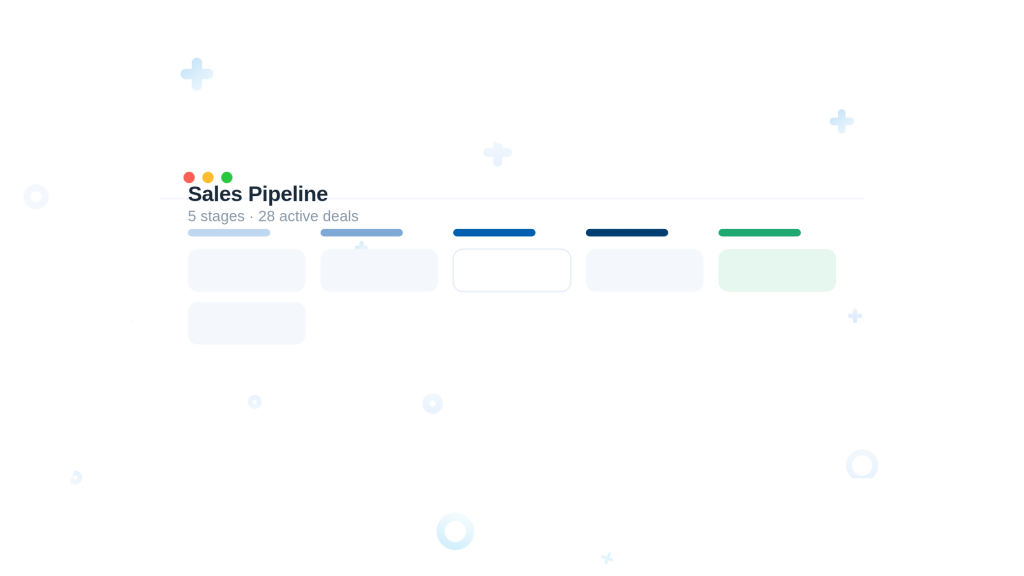
In Nimble’s Deals feature, each pipeline has customizable stages, a Kanban board view and a list view, and deal-level fields for value, probability, expected close date, and custom information specific to your business. Deals can be tagged, filtered by stage or tag, and sorted by value or expected close date. The “stuck deal” indicator turns a deal red when it has sat in the same stage longer than the threshold you set — so deals going cold are visible before they’re gone.
Multiple pipelines let different parts of the business run their own deal processes. A consulting firm might have a client pipeline, a partnership pipeline, and a speaking engagement pipeline — all separate, all visible in the same dashboard, all writing to the same contact record. Creating a new pipeline takes about two minutes in Settings.
Growth Playbook
The Small Business Growth Playbook
Practical plays to sell, market, and grow — on the relationships you already have.
- Build a pipeline that fills itself
- Turn one-time buyers into regulars
- Follow up without the busywork
- Grow without adding headcount
Download Free
You’re All Set!
DownloadGet the most out of this guide by starting your free 14-day trial of Nimble today.
The Five Things Every Deal Needs
A stage. Every deal should sit in a clearly defined stage with a clear definition of what it means to be there. “Proposal sent” means a proposal has gone out. Not “I’m thinking about sending a proposal.” The stage represents where the deal actually is, not where you hope it’s going.
A value. Even a rough estimate. Without a value, the pipeline has no revenue signal — you can’t tell whether you’re tracking $10,000 in opportunities or $200,000. It also focuses the mind on which deals deserve the most time.
A next action. A deal without a next action is a hope, not a pipeline entry. Every deal should have a task attached — a call scheduled, a proposal due, a follow-up email queued. If there’s no next action, the deal sits and goes cold.
An expected close date. Forces realism about timing and creates the data that makes revenue forecasting possible. A pipeline full of deals with no close dates is a wishlist.
An owner. In a team context, every deal should have a clear owner — the person responsible for moving it forward. Without an owner, deals fall through because everyone assumes someone else is handling it.
A four-person B2B software company had 47 deals in their pipeline at any given time — but was only closing two or three a month. The problem wasn’t the deals. It was that 30 of the 47 had no next action, no expected close date, and hadn’t moved in over 60 days. They were clutter, not pipeline.
After setting a rule that any deal without a next action gets archived after 14 days of no movement, the pipeline dropped to 18 deals. Revenue didn’t change. Visibility did — the team could now see exactly which deals needed attention and what the realistic month looked like. Close rate improved not because they found better deals, but because they stopped letting good ones go cold inside a cluttered pipeline.
For a detailed guide on building and managing a sales pipeline that actually moves deals forward, see our post on sales pipeline management best practices.
Closing: Pitches, Proposals, and Handling Objections
Closing is the part of sales most people spend the most time worrying about and the least time preparing for. The close rarely fails because of a closing technique — it fails because something earlier in the process went wrong. The pitch didn’t connect the product to the prospect’s specific problem. The proposal didn’t address the objection the prospect was privately holding. The follow-up went quiet at exactly the wrong moment.
The Sales Pitch
A sales pitch for a small business context is not a deck and a demo. It’s a conversation that moves in a specific direction: from their problem to your solution to why you specifically. The structure that works: start with what you understand about their situation (demonstrates you’ve done your homework and earns permission to continue), describe what a good outcome looks like for them (shifts the conversation from features to results), explain how your product gets them there (specific, not generic), and give them one clear next step (not three options — one).
The most common pitch mistake in a small business context is leading with the product before establishing the problem. “We’re a CRM that does X, Y, and Z” lands very differently than “Most teams in your position are managing relationships in Gmail and losing deals because nothing is tracked — here’s how we fix that.” Same product, completely different framing. The second one starts from their reality, not yours.
Handling Objections
Most sales objections are one of four things: price (“it’s too expensive”), timing (“now isn’t a good time”), fit (“I’m not sure it’s right for us”), or trust (“I need to think about it”). Price objections are usually value objections in disguise — the prospect doesn’t see enough return to justify the cost, which means the pitch didn’t land the ROI case clearly enough. Timing objections are often real but worth exploring — “not now” sometimes means “not until I understand this better.” Fit objections need honest engagement, not dismissal. Trust objections need time and proof, not pressure.
The response to any objection follows the same structure: acknowledge it genuinely, ask a clarifying question to understand what’s underneath it, and address the real concern rather than the surface statement. “That’s too expensive” answered with a discount is a short-term win and a long-term problem. “That’s too expensive — can I ask what you’re comparing it to?” is a conversation that might actually move somewhere.
Growth Playbook
The Small Business Growth Playbook
Practical plays to sell, market, and grow — on the relationships you already have.
- Build a pipeline that fills itself
- Turn one-time buyers into regulars
- Follow up without the busywork
- Grow without adding headcount
Download Free
You’re All Set!
DownloadGet the most out of this guide by starting your free 14-day trial of Nimble today.
The Proposal
A proposal is not a brochure. It should be short enough to read in five minutes, specific enough to address the exact situation you discussed, and structured to make the decision easy. The elements that matter: a one-paragraph summary of the problem as you understand it (confirms you were listening), the specific solution you’re proposing (not every option you offer), the investment and what it covers, and a clear next step with a deadline. The proposal that goes out the day after the discovery call closes faster than the proposal that gets polished for two weeks.
Sales Reporting: What to Actually Measure
Most small business sales reporting focuses on the wrong end of the funnel. Revenue closed is the output — it tells you what happened, not what’s about to happen or why. The metrics that actually help you improve are the leading indicators: the activities that predict revenue before it shows up.
The Metrics That Matter
Pipeline value by stage. The total value of deals in each stage, weighted by probability. This is your revenue forecast — imperfect but directionally useful. A pipeline with $200,000 in the proposal stage and a 40% close rate suggests $80,000 in expected revenue from that stage alone. Without this number, revenue planning is guesswork.
Conversion rate by stage. What percentage of deals move from each stage to the next? A low conversion rate from Discovery to Proposal usually means qualification is failing — you’re doing discovery calls with people who aren’t ready to buy. A low conversion from Proposal to Close usually means the proposal isn’t landing the value case clearly enough. The stage where deals stall tells you where to focus.
Average deal cycle length. How long does it typically take from first contact to close? This determines how much pipeline you need to generate your target revenue — if your average deal takes 60 days and you want to close $50,000 next month, you need that pipeline built today. See our post on <a href=”https://www.nimble.com/blog/how-many-touchpoints-does-it-take-to-close-a-sale/” target=”_blank” rel=”noopener”>how many touchpoints it takes to close a sale</a> for context on what typical cycles look like.
Deals lost by reason. Nimble’s lost reason tracking lets you log why a deal closed as lost — price, timing, competitor, no decision. Over time this data tells you whether your pricing is consistently blocking deals, whether a specific competitor keeps winning, or whether your qualification process is letting too many “no decision” leads into the pipeline.
Sequence performance. Reply rate per sequence and per email within a sequence. A declining reply rate across a four-email sequence tells you exactly where the conversation is losing people. This is the leading indicator for outreach quality — weeks before it shows up in pipeline metrics.
Sales Tools: What a Small Business Actually Needs
The average small business sales stack costs $500–$2,000 per month and involves five or more tools that don’t fully talk to each other. A prospecting tool for finding contacts. A CRM for storing them. A sequencing tool for outreach. An email platform for campaigns. A reporting tool for the numbers. Each one has its own login, its own data model, and its own version of the contact record — which means every sync is a potential source of errors and every handoff is a potential place for a lead to fall through.
The case for consolidation is straightforward: fewer tools means fewer integration points to break, fewer places for contact data to go stale, and fewer logins to manage. It also means every team member is working from the same information — which is the condition that makes coordination possible without meetings.
Growth Playbook
The Small Business Growth Playbook
Practical plays to sell, market, and grow — on the relationships you already have.
- Build a pipeline that fills itself
- Turn one-time buyers into regulars
- Follow up without the busywork
- Grow without adding headcount
Download Free
You’re All Set!
DownloadGet the most out of this guide by starting your free 14-day trial of Nimble today.
What You Actually Need
A way to find and enrich contacts. Prospector handles this — pull a contact from LinkedIn, a company website, or an email signature and the record is created in Nimble with verified contact information already populated.
A way to manage and organize those contacts. The CRM contact record — enriched automatically, updated by email sync, visible to the whole team. Tags, custom fields, saved segments, stay-in-touch reminders.
A way to reach out at scale without losing the personal feel. Group Messages for targeted one-to-many sends, Sequences for automated multi-step follow-up that exits when someone replies. Both send from your actual email address.
A way to track which leads are qualified and which aren’t. Workflows — the pre-pipeline Kanban board where leads live until they’re ready to become deals.
A way to track deals and forecast revenue. The Deals pipeline — customizable stages, stuck deal indicators, multiple pipelines for different business lines, and reporting that shows conversion rates, deals won and lost, and revenue by stage.
A way to capture inbound leads automatically. Web Forms and Web Chat — so every website visitor who raises their hand enters the system without manual work, gets tagged based on how they came in, and fires a follow-up sequence before you’ve seen the notification.
In Nimble, all of these live in the same platform under the same contact record at $25 per seat per month. For a full comparison of what this stack costs when assembled from separate tools, see our guide to CRM for small business.
Putting It Together: What a Small Business Sales System Looks Like
The pieces covered in this guide are not independent tactics. They’re a connected system — and the connection is what makes it work. Here is what the full loop looks like end to end.
A prospect is identified through Prospector or inbound. Their contact record is created in Nimble — enriched, tagged by ICP segment, and assigned to a rep. A sequence fires automatically or is manually enrolled. Three to five emails go out over two weeks. The prospect replies to email two.
The sequence stops. The contact moves into the lead qualification Workflow. The rep sees the new card, reviews the engagement history on the contact record, and schedules a discovery call. After the call, the rep logs a note, updates the workflow stage to Discovery Complete, and creates a task to send a proposal within 48 hours.
The proposal goes out. The contact moves to the Proposal stage in the Deal pipeline. The deal has a value, a close date, and the rep as owner. If the prospect goes quiet, the stuck deal indicator fires after 10 days. The rep follows up. The deal closes.
The contact moves from the prospect segment to the customer segment. An onboarding sequence fires. The deal is logged as Won with a close reason. The lost-by-reason dashboard stays clean. The pipeline resets for the next month.
That system — prospect, outreach, qualify, pipeline, close, report — running on one contact record, without manual data entry between steps, is what separates a small business that scales its sales from one that plateaus at whatever the founder can personally manage. The tools are not the point. The architecture is.
Your sales system. One platform.
Prospecting, sequences, workflows, pipeline, and reporting — all on one contact record.
Try Nimble Free →14-day free trial. No credit card needed. Immediate access.