

Last updated:
Most small businesses don’t have a lead generation problem. They have a system problem.
Leads come in from a dozen directions — referrals, your website, LinkedIn, events, cold outreach. Some get followed up on. Most don’t. The ones that do get a single email, then silence. Deals that should close in 30 days drag out to 90, or disappear entirely.
This guide covers the full lead generation process for small businesses: how to attract leads, capture them properly, qualify them quickly, and work them through a pipeline without letting anything fall through the cracks. It’s built around what actually works at a small business scale — not enterprise playbooks stripped of context.
The lead generation funnel for small businesses
Before diving into tactics, it helps to understand the stages every lead moves through — and where most small businesses lose them.
The funnel has four stages:
- Attract — Get in front of people who fit your ideal customer profile
- Capture — Convert attention into a contact you can follow up with
- Qualify — Figure out who’s worth your time
- Nurture and close — Follow up consistently until they buy, refer, or opt out
Most small businesses invest heavily in “attract” — running ads, posting on social media, attending events — and then do almost nothing at the capture, qualify, and nurture stages. That’s where the system breaks down.
How to attract leads as a small business
You don’t need to be everywhere. Most small businesses succeed by being very visible in two or three channels rather than spread thin across eight.
Search (organic and paid)
Search is the highest-intent lead source available. Someone typing “CRM for small business” or “accountant for freelancers” is already in buying mode. Ranking for those terms — through SEO, Google Ads, or both — puts you in front of people who are actively looking.
For organic search, the strategy is straightforward: write detailed content that answers the specific questions your ideal customers are asking. Not generic articles — specific, opinionated pieces that demonstrate you understand their problems. Google rewards depth and relevance, not volume.
For paid search, start narrow. Target the three to five keywords with the clearest commercial intent and measure cost per lead against customer lifetime value before expanding.
Growth Playbook
The Small Business Growth Playbook
Practical plays to sell, market, and grow — on the relationships you already have.
- Build a pipeline that fills itself
- Turn one-time buyers into regulars
- Follow up without the busywork
- Grow without adding headcount
Download Free
You’re All Set!
DownloadGet the most out of this guide by starting your free 14-day trial of Nimble today.
Referrals
Referrals are the most underutilized lead source for small businesses. They convert at higher rates, close faster, and tend to be better-fit customers. The problem is that most businesses treat referrals as something that happens passively — if they happen at all.
A basic referral system has three components: a trigger (when do you ask?), an ask (what do you say?), and a process (how do you track and follow up on referrals given?). Most businesses have none of these defined.
LinkedIn and social outreach
For B2B small businesses, LinkedIn is the best social channel for lead generation — not because organic content reliably generates leads, but because it supports direct outreach at scale. Building a targeted list of prospects, connecting, and starting genuine conversations is a proven approach for many service businesses.
The keyword is “genuine.” Connection requests that immediately pitch a service get ignored. Outreach that references something specific about the person’s work or situation gets responses.
Content and email
Content generates leads indirectly — a piece that ranks well or gets shared brings visitors to your site, and a lead capture mechanism converts some of those visitors into contacts. Email then nurtures those contacts over time.
This is a longer-cycle channel than paid search or direct outreach, but the leads it generates tend to be warmer and better-informed. Someone who has read three of your articles before reaching out already knows what you do and whether it fits their situation.
Lead capture — turning attention into a contact
Getting someone’s attention is worth nothing if you don’t capture it. Lead capture means collecting a name, email address, and enough context to qualify and follow up.
Web forms
A web form is the most basic capture mechanism. Most small business websites have a contact form buried in the footer, which is the lowest-converting placement possible. High-performing capture uses forms that appear at relevant moments: on pricing pages, at the end of valuable content, or triggered by exit intent.
Keep forms short. Name, email, and one qualifying question are usually enough. Every additional field reduces completion rates. If you need more information, collect it after they’ve submitted — via a follow-up call or a short onboarding questionnaire.
Lead magnets
A lead magnet gives someone a reason to share their email address — a template, checklist, guide, or tool they’d find valuable. The best lead magnets are highly specific and immediately useful. “The ultimate marketing guide” is not a lead magnet. “A prospect list template for financial advisors” is.
The specificity matters because it also qualifies the lead. Someone who downloads a financial advisor prospecting template is much more likely to be your ideal customer than someone who downloaded a generic sales guide.
Growth Playbook
The Small Business Growth Playbook
Practical plays to sell, market, and grow — on the relationships you already have.
- Build a pipeline that fills itself
- Turn one-time buyers into regulars
- Follow up without the busywork
- Grow without adding headcount
Download Free
You’re All Set!
DownloadGet the most out of this guide by starting your free 14-day trial of Nimble today.
CRM capture tools
Manual data entry kills capture. Every lead that has to be hand-typed into a spreadsheet is a lead that might get missed, entered incorrectly, or added two weeks late.
Tools like Nimble’s browser extension capture contact information directly from LinkedIn profiles, email signatures, and websites — without leaving your workflow. The contact lands in your CRM instantly, with social enrichment already pulled in.Lead qualification — who’s worth your time?
Not every lead deserves the same follow-up effort. Qualification is the process of figuring out which leads have real potential so you can allocate your time accordingly.
BANT as a starting framework
BANT — Budget, Authority, Need, Timeline — is the classic qualification framework. It’s not perfect, but it works as a starting point:
- Budget: Do they have money to spend on a solution like yours?
- Authority: Are you talking to the decision-maker, or someone who has to go ask?
- Need: Do they have a problem your product actually solves?
- Timeline: Are they planning to do something about it in the next 30 to 90 days?
You don’t need to run through these four questions like a checklist. But you do need answers to all four before investing significant time in a prospect.
Lead scoring
Lead scoring assigns a numerical value to leads based on their fit and behavior — who they are, what they’ve done on your website, and how they’ve engaged with your emails. A lead from a 15-person professional services firm who visited your pricing page twice scores higher than a student who downloaded a free template.
For small businesses, lead scoring doesn’t need to be automated or complex. A simple spreadsheet with three to five criteria — company size, role, industry, engagement level, and source — scores most leads well enough. The goal is to sort your pipeline by potential, not to build a machine learning model.
Free Guide
The ABCs of CRM
A Beginner's Guide to Understanding &
Using a CRM
Download Free
You’re All Set!
DownloadGet the most out of this guide by starting your free 14-day trial of Nimble today.
For a deeper look at how to build this out, see CRM best practices for lead scoring and qualification.
Building a prospect list
Inbound leads are great when they come in. The problem is they’re unpredictable. A prospect list gives you a pool of qualified targets you can work proactively — people who match your ideal customer profile, whether or not they’ve raised their hand yet.
A good prospect list starts with criteria: what industry, role, company size, geography, and signals make someone worth reaching out to? Then you build the list using LinkedIn Sales Navigator, Apollo, or manual research, and import it into your CRM.
For the mechanics of doing this well, see how to build a prospect list.
The follow-up problem — and how to fix it
This is where most small businesses lose the most deals. Not at the top of the funnel — at follow-up.
The research on this is consistent: most sales require five to eight touchpoints to close, and most salespeople give up after one or two. The leads don’t go away — they just buy from whoever follows up.
Why follow-up breaks down
Follow-up breaks down for a few reasons. First, there’s no defined cadence — salespeople follow up when they feel like it rather than on a schedule. Second, there’s no system to track who needs a follow-up and when. Third, it feels awkward, so people avoid it.
All three of these are fixable.
Defining a follow-up cadence
A follow-up cadence is a defined sequence of touchpoints — email, phone, LinkedIn message, or some combination — at specific intervals after initial contact. A basic cadence for a warm-up lead might look like:
- Day 1: Initial outreach or response to inbound
- Day 3: Follow-up email if no response
- Day 7: Second follow-up, different angle
- Day 14: Check in with something of value (article, referral, relevant news)
- Day 21: Light touch (“still open to connecting?”)
- Day 30: Final follow-up, then move to long-term nurture
This isn’t the only way to structure a cadence, and the right intervals vary by industry and deal size. But having any defined cadence dramatically outperforms following up at random.
For templates and examples across different situations, see how to follow up in sales without annoying your prospects.
Automating follow-up sequences
Once a cadence is defined, the next step is automating as much of it as possible. Email sequences — pre-written emails sent at defined intervals — remove the “I need to remember to follow up” problem entirely.
This doesn’t mean every email is robotic. The first and last touch in a sequence should be personalized. The middle touches can be templated. The goal is to stay present without requiring manual effort for every single touchpoint.
Managing leads in a CRM pipeline
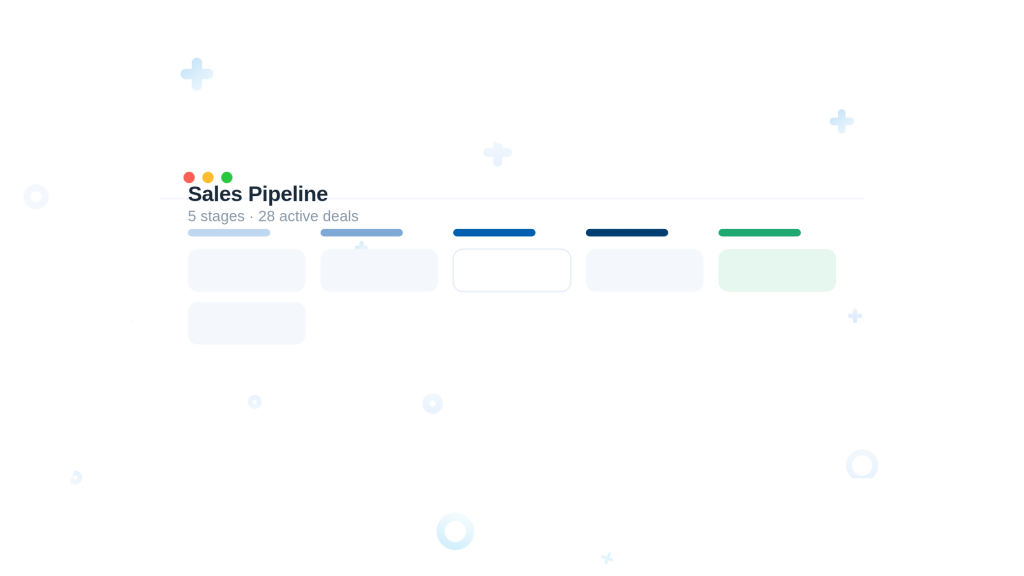
A contact list is not a pipeline. A pipeline is a defined set of stages that lead to a move through, with clear criteria for when they advance and clear owners for each stage.
Pipeline stages for small businesses
Most small businesses need four to six pipeline stages. A typical setup:
- New — Lead has been captured, not yet contacted
- Contacted — First outreach sent or made
- Qualified — BANT criteria checked, real opportunity confirmed
- Proposal / Demo — Proposal sent or demo scheduled
- Negotiation — Terms being discussed
- Closed Won / Closed Lost — Deal decided
The right stages for your business depend on your sales process. If you sell a $200/month SaaS product with a free trial, your pipeline looks different than if you close $50,000 consulting engagements. The key is that every stage reflects a real milestone — not just “talked to them again.”
Lead assignment
In solo or two-person operations, lead assignment is simple. In slightly larger teams, it becomes critical — and most small businesses handle it poorly. Leads get assigned based on who happens to see the notification, or whoever is least busy at the moment, with no logic behind it.
A basic lead assignment framework considers territory, vertical, capacity, and source. A lead from a financial services firm should probably go to the rep with financial services experience. A lead from a referral partner should go to the rep managing that relationship. Getting this right improves conversion rates more than almost any other change in the sales process.
For a detailed breakdown, see best practices for lead assignment in CRM.
Keeping the pipeline clean
A pipeline only works if it’s accurate. Most small business pipelines are full of deals that have been sitting in “Proposal Sent” for six months and will never close. Those deals make your pipeline metrics meaningless and create false confidence about revenue.
A weekly pipeline review — even 30 minutes — keeps things clean. Any deal that hasn’t moved in 30 days gets a status update or gets moved to a nurture list. Any deal with no activity in 60 days gets closed out. This isn’t about being pessimistic — it’s about knowing what you actually have.
Lead nurture — staying in front of the not-yet-ready
The majority of leads who come in aren’t ready to buy right now. That doesn’t mean they’ll never buy — it means the timing isn’t right. Lead nurture is what you do to stay relevant until the timing changes.
Email nurture sequences
A nurture sequence is different from a follow-up sequence. A follow-up sequence is for active leads you’re trying to close. A nurture sequence is for leads who have opted out of the immediate conversation but are still worth staying connected with.
Good nurture emails aren’t pitches. They’re useful: a relevant article, an industry insight, a case study from a similar company, a seasonal check-in. The goal is to demonstrate value consistently so that when the timing changes, you’re the first call they make.
Contact management and enrichment
Nurture only works if your contact data is accurate. Phone numbers change. People move companies. Email addresses go stale. A CRM with automatic contact enrichment updates records over time so you’re not sending carefully crafted nurture emails to addresses that bounce.
Nimble enriches contacts automatically from social media and public data — so your contact records stay current without manual upkeep.
Lead generation tools for small businesses
The right tools depend on your channels and process. Here’s what most small businesses actually need.
CRM
A CRM is the foundation of any lead generation system. It’s where contacts live, where follow-up gets tracked, where pipeline stages are managed, and where activity history is recorded. Without a CRM, lead generation is a collection of scattered spreadsheets, sticky notes, and forgotten follow-ups.
For small businesses, the right CRM is one that’s actually usable — not a system that requires a dedicated admin to maintain. Nimble is built specifically for small businesses and relationship-driven teams, with automatic contact enrichment, built-in email sequences, and a browser extension for capture.
Prospecting tools
If outbound is part of your strategy, you need a way to build lists of qualified prospects. Tools like LinkedIn Sales Navigator, Apollo, and ZoomInfo serve different ends of the market — Sales Navigator for relationship-focused outreach, Apollo for volume prospecting, ZoomInfo for enterprise teams with large budgets.
For AI-assisted prospecting, see the best AI tools for sales prospecting.
Email marketing
Email marketing handles nurture at scale — sending relevant content to segmented lists based on where contacts are in the funnel. For small businesses, a simple setup (a CRM with built-in email capabilities, or a CRM integrated with a tool like Mailchimp or ActiveCampaign) is usually sufficient.
Lead capture tools
Web forms, chatbots, and landing page builders all serve the capture function. The most important thing isn’t which tool you use — it’s that leads captured by these tools flow directly into your CRM without manual entry.
Growth Playbook
The Small Business Growth Playbook
Practical plays to sell, market, and grow — on the relationships you already have.
- Build a pipeline that fills itself
- Turn one-time buyers into regulars
- Follow up without the busywork
- Grow without adding headcount
Download Free
You’re All Set!
DownloadGet the most out of this guide by starting your free 14-day trial of Nimble today.
Measuring lead generation performance
You can’t improve what you don’t measure. The metrics that matter most:
- Lead volume by source — Where are leads coming from? Which sources are growing?
- Lead-to-qualified rate — What percentage of leads pass qualification?
- Qualified-to-close rate — Of qualified leads, how many become customers?
- Average deal size — What’s the revenue per closed deal?
- Sales cycle length — How long does it take from first contact to close?
- Cost per lead by channel — What does it cost to acquire a lead from each source?
Most small businesses track none of these. They know how many sales they made last month, but not where those customers came from, how long the sales cycle took, or which lead source had the best conversion rate. Start with lead volume by source and qualified-to-close rate — those two metrics reveal more about your system than anything else.
Common lead generation mistakes to avoid
- Confusing activity with results. Sending 200 cold emails is an activity. Getting 10 qualified conversations from those emails is a result. Track outcomes, not output.
- Ignoring existing contacts. Most small businesses have years of contacts — past clients, old leads, conference connections — sitting inactive in a spreadsheet or old CRM. These people already know who you are. They’re often easier to reactivate than to acquire from scratch.
- Skipping qualification. Treating every lead the same wastes time on low-potential prospects and underinvests in high-potential ones. Qualify early and adjust effort accordingly.
- One-touch follow-up. One email and then nothing is a follow-up strategy. Define a cadence and stick to it.
- No CRM. A business running lead generation without a CRM is running lead generation without institutional memory. Every time a salesperson leaves, goes on vacation, or gets overwhelmed, leads fall through the cracks. A CRM fixes this.
Building a lead generation system that scales
The goal isn’t to generate more leads. The goal is to build a system that reliably converts leads into customers — and then find ways to increase the volume of leads entering that system.
Start with the middle of the funnel, not the top. Fix your qualification process. Define your follow-up cadence. Get your CRM set up and actually used. Then increase lead volume with the confidence that more leads will turn into more customers — not just more noise.
The businesses that grow consistently aren’t the ones running the most ads or attending the most events. They’re the ones with a system that handles what comes in.
- How to Build a Prospect List
- CRM Best Practices for Lead Scoring and Qualification
- Best Practices for Lead Assignment in CRM
- How to Follow Up in Sales Without Annoying Your Prospects
- Best Lead Capturing CRMs for Small Businesses
- Automated Follow-Up for New Leads with a CRM
- Best AI Tools for Sales Prospecting
- How to Research Prospects Before Sales Outreach Using a CRM