

When small teams search for a Lusha alternative, they are typically solving for operational friction rather than just data quality. While data-only tools excel at surfacing contact info, they often create a “Frankenstack“—a disconnected mess of tabs and manual syncs that slows down outreach.
For lean teams, the goal is shifting from “How do we find contacts?“ to “How do we manage the entire relationship in one place?“
Nimble solves this by embedding sales prospecting and contact enrichment directly into the CRM workflow.
Instead of treating data access as a standalone task, Nimble integrates enrichment, email outreach, and follow-up into a single system.
This approach offers a practical, unified alternative for SMBs looking to eliminate administrative overhead and reclaim their selling time.
Beyond the Credit System: Why SMBs Are Seeking a Lusha Alternative
Many SMBs start looking for a Lusha alternative when credit-based pricing begins to slow prospecting.
While credits can feel flexible at first, they often introduce both operational and psychological friction as outbound activity scales.
In a typical Lusha workflow:
- Contact enrichment happens outside the CRM
- Reps spend credits before a lead enters the system of record
- Data must be exported or synced before outreach can begin
This model also creates “Enrichment Anxiety.”
Every time a rep clicks Reveal, they are consciously spending company money.
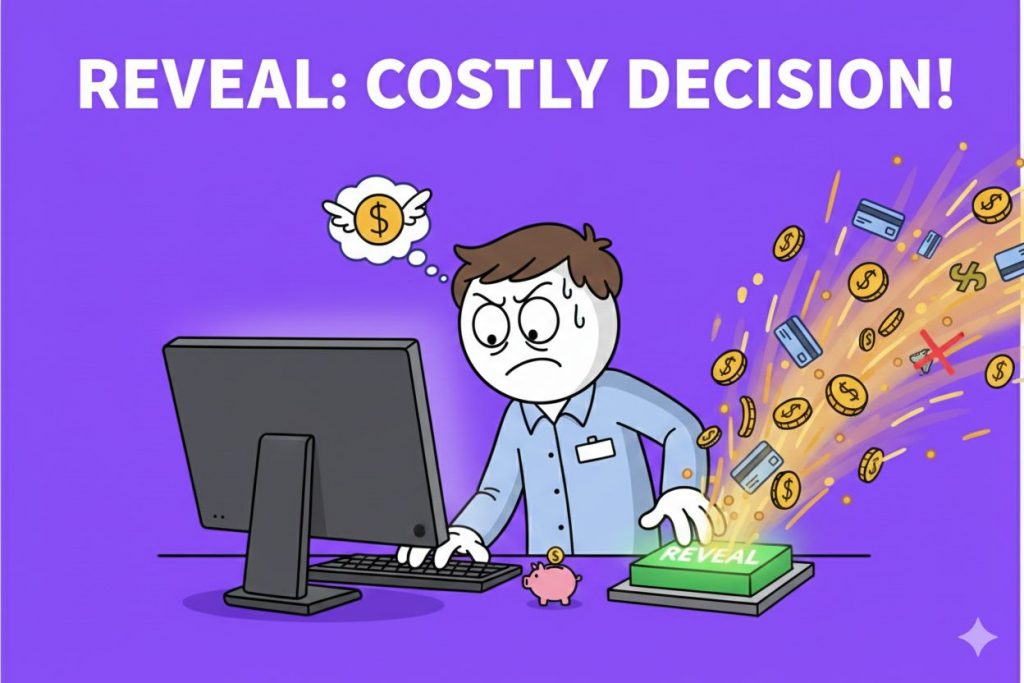
That moment of friction leads to hesitation, over-selectivity, and fewer experiments with new segments—shifting prospecting from exploratory to conservative.
Nimble takes a different approach.
Enrichment happens inside the CRM, alongside contact records and active outreach.
This enables intent-driven enrichment—adding data when it directly supports personalization, qualification, or follow-up, rather than forcing enrichment upfront.
For SMBs, the difference isn’t whether enrichment exists. It’s whether enrichment accelerates momentum or interrupts it.
When enrichment is embedded in a flat-rate CRM, teams move faster, with more confidence, and less friction at every stage of outreach.
Fragmentation vs. Unification: The Hidden Cost of “Data-Only” Tools
For many small sales teams, using Lusha is rarely a standalone decision.
It typically becomes one part of a broader stack.
Individually, each tool may perform its function well.
Collectively, however, they create a fragmented workflow that adds hidden operational costs.
This “Frankenstack” usually looks something like this:
- Lusha for contact data,
- a CRM for record-keeping,
- and an email platform for outbound outreach.
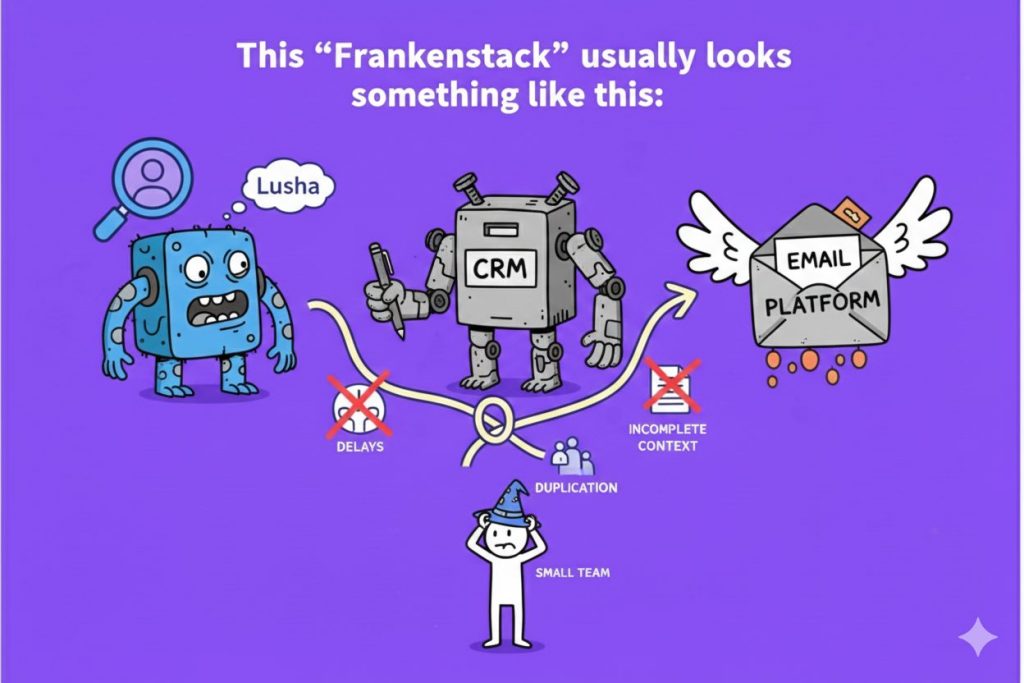
Data moves between these systems through exports, browser extensions, or background syncs.
Each handoff introduces the risk of delays, duplication, or incomplete context, especially for small teams without dedicated RevOps support.
Fragmentation impacts more than just efficiency.
It affects visibility and consistency across the sales process.
When prospecting happens in one tool, communication in another, and relationship history in a third, it becomes difficult to maintain a complete view of an account.
Fragmentation impacts more than efficiency; it creates a scenario where sales reps spend more time updating records and less time engaging prospects.
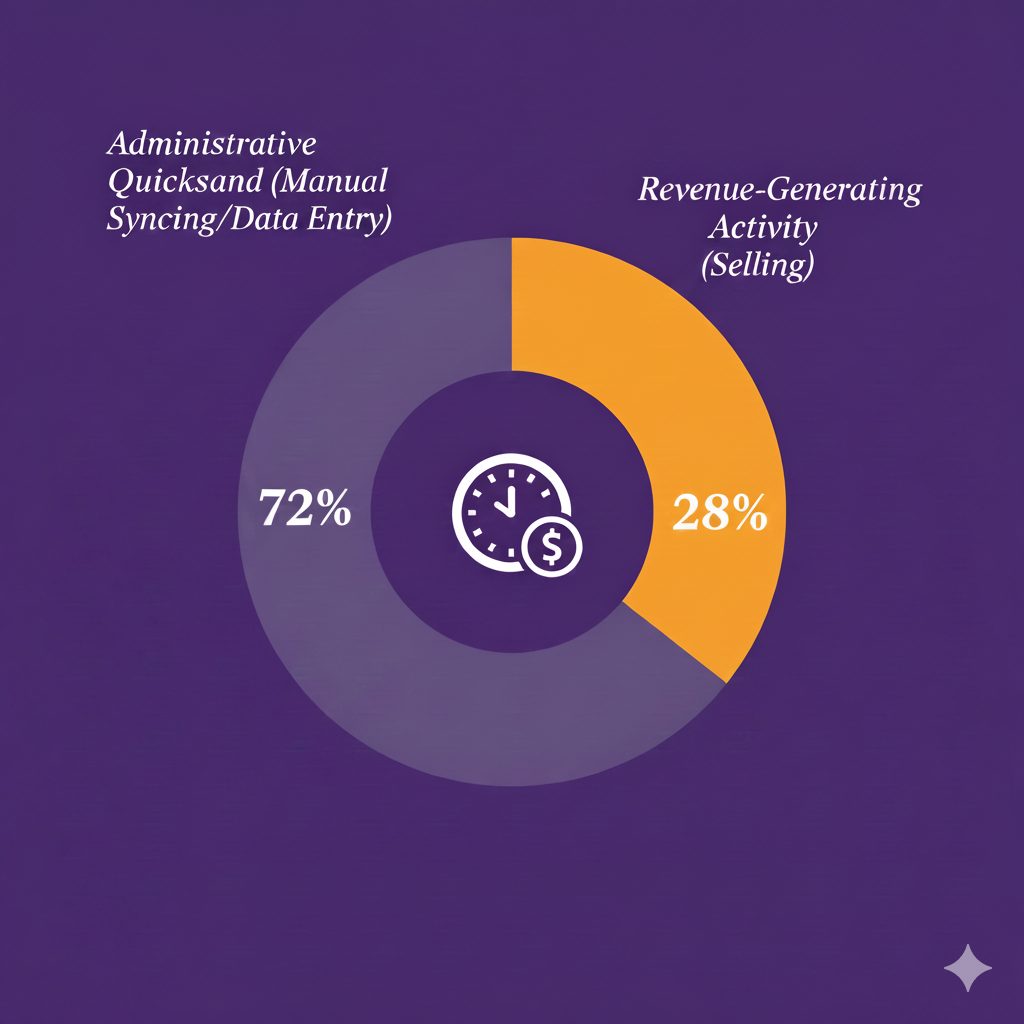
In fact, industry data shows that many reps spend as little as 28% of their day actually selling.
Free Guide
The ABCs of CRM
A Beginner's Guide to Understanding &
Using a CRM
Download Free
You’re All Set!
DownloadGet the most out of this guide by starting your free 14-day trial of Nimble today.
The “Selling vs. Admin” Reality Check
The Cost of the Frankenstack While your team aims for growth, fragmented tools like Lusha-only stacks force them into a clerical role. Industry data shows a staggering gap between intent and action:
- Time Spent Selling: Only 28% of the average sales week.
- Time Lost to Admin: 72% of the week is consumed by data entry, manual syncing, and research.
The Nimble Fix: By unifying prospecting and CRM, Nimble automates the “quicksand” tasks, moving your team closer to a 100% selling motion.
This is where many teams begin reassessing their approach and looking for a Lusha alternative that reduces complexity rather than adding to it.
The challenge is not that Lusha lacks CRM features; it is that data-only tools are not designed to manage the full lifecycle of a sales relationship. They assume another system will handle what comes next.
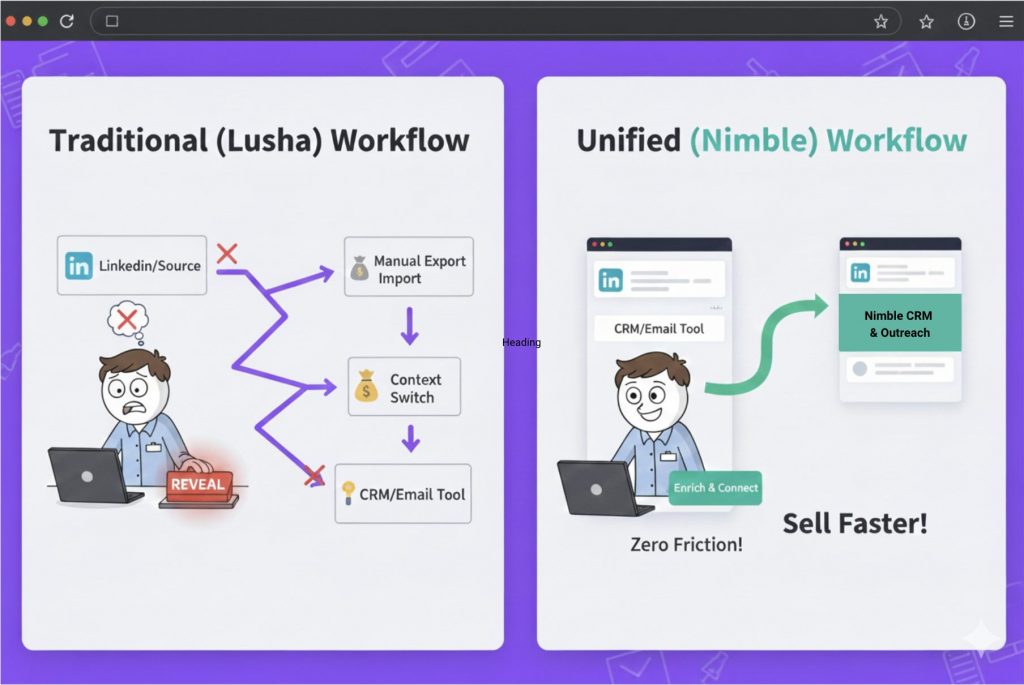
Nimble takes a unification-first approach.
Instead of layering prospecting on top of an existing stack, Nimble combines sales prospecting, contact enrichment, email outreach, and relationship management inside a single unified CRM.
This eliminates the need to move data between tools before meaningful engagement can begin.
For SMBs, this shift has practical implications.
Prospecting activity is automatically connected to contact records. Outreach history lives alongside enrichment data. Follow-ups, notes, and next steps remain visible to the entire team without manual syncing. The result is a workflow that is easier to adopt, easier to manage, and easier to scale.
From Feature Overload to Seamless Flow: Why This Small Business Founder Returned to Nimble
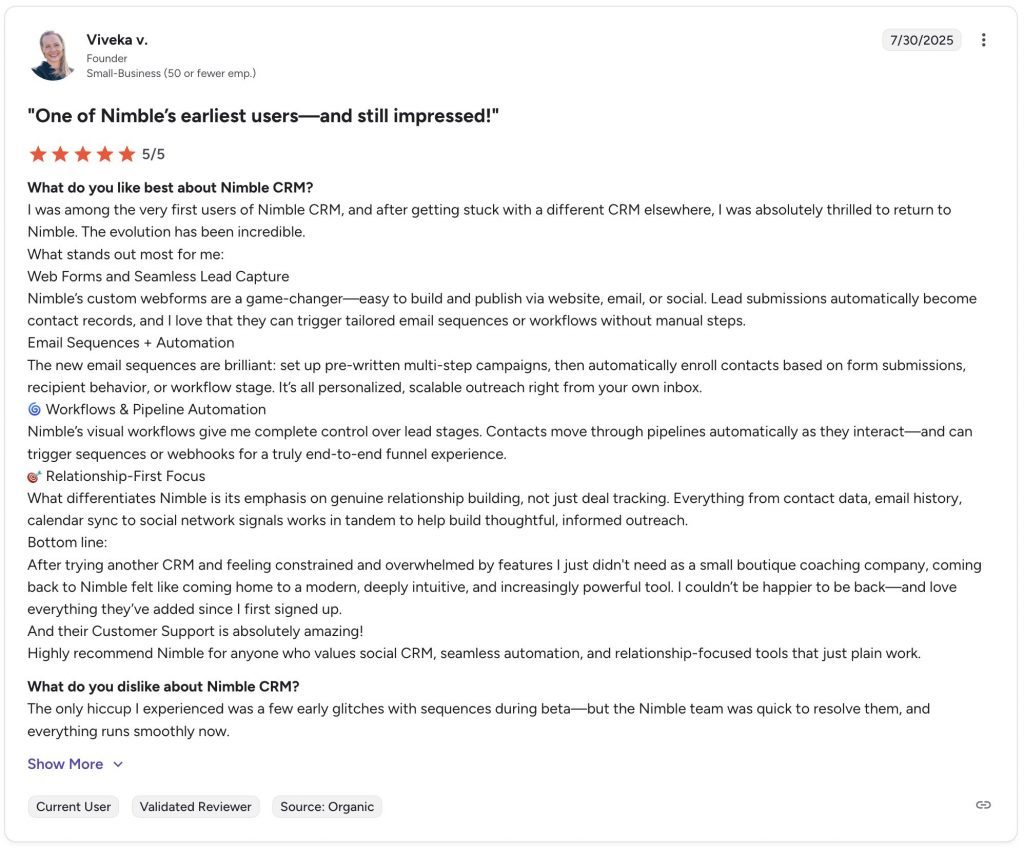
As a Lusha alternative, Nimble’s value is not in replacing one point solution with another, but in removing the operational gaps that slow small teams down.
By reducing fragmentation, Nimble allows sales teams to focus on execution rather than tool coordination, which is often the difference between a stack that looks good on paper and one that actually performs.
Nimble Prospector: Sales Intelligence Without the Enterprise Price Tag
For SMBs evaluating a Lusha alternative, the real challenge isn’t access to data—it’s escaping the administrative quicksand that slows prospecting down. In most sales workflows, there’s a 5–10 minute gap between finding a lead on LinkedIn and actually sending a relevant email, filled with manual data entry, tab switching, and context rebuilding.
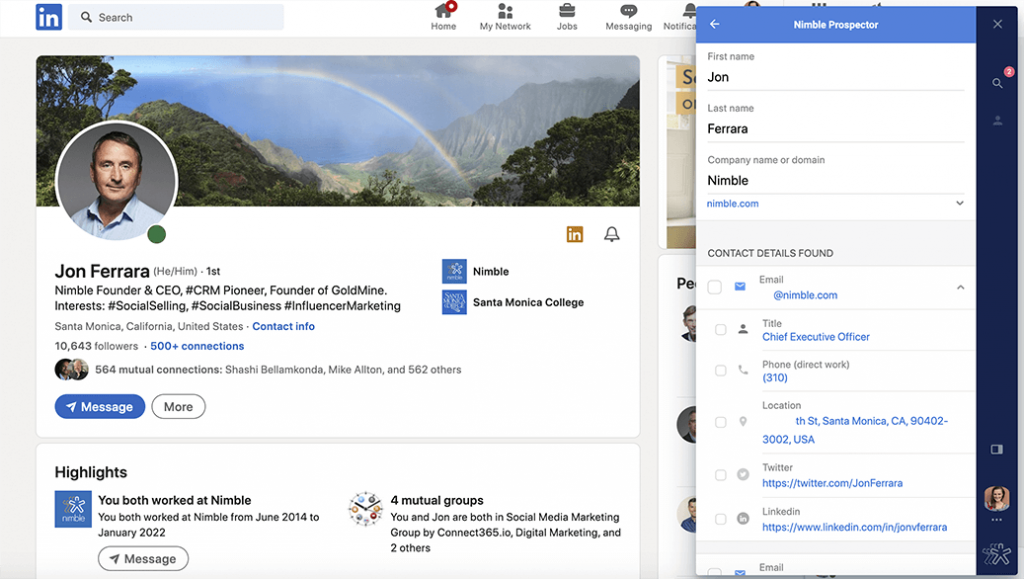
Nimble Prospector eliminates that gap by embedding sales intelligence directly into a unified CRM. Prospecting, enrichment, and engagement happen in the same environment, so reps can move from discovery to outreach without losing momentum.
Instead of delivering a cold email address in isolation, Nimble creates actionable context:
- Contacts are captured directly from LinkedIn, websites, and online sources with 1-click social enrichment
- Each lead becomes a Live Profile, enriched with verified business data, social insights, and engagement history
- Reps know who they’re reaching out to—and why—before sending the first message
Because Nimble Prospector lives inside the browser and the CRM, contacts are immediately usable:
- Notes, tags, tasks, and ownership are applied instantly
- Reps can draft AI-assisted emails and enroll contacts into Sequences without leaving the profile
- Outreach starts in seconds, not minutes
This workflow also turns enriched contacts into relationship assets, not rented data. Unlike credit-based tools where value disappears after export, every enriched contact in Nimble becomes a permanent, searchable part of the CRM timeline—complete with enrichment history, emails sent, replies, and follow-ups.
As a Lusha alternative, Nimble Prospector stands out by removing friction at the exact moment it matters most. By combining browser-based capture, live enrichment, AI-assisted outreach, and CRM-native automation, Nimble helps SMB sales teams prospect at volume—without the overhead, hesitation, or tool sprawl that slows growth.
Turning Data into Action: From Web Forms to Automated Outreach
For many sales teams, the gap between capturing a lead and engaging that lead is where momentum is lost. Contact data may exist, but without a clear path into outreach, follow-up is delayed or inconsistent. This is especially common in stacks where inbound leads, prospecting tools, and email platforms operate independently.
Nimble closes this gap by connecting inbound and outbound activity inside a unified CRM. Leads captured through intelligent web forms are automatically enriched, organized, and routed into the appropriate workflows without requiring manual intervention. Instead of entering a queue and waiting for action, new contacts can immediately become part of an active engagement process.
Once a lead enters the system, teams can trigger automated email sequences based on form submissions, tags, or other criteria. This allows SMBs to respond quickly while still maintaining personalization. Outreach feels timely and relevant because it is driven by context already stored in the CRM, not by disconnected automation rules.
Nimble’s AI-powered email marketing further supports this transition from data to action. Sales reps can optimize subject lines, refine messaging, and improve clarity before messages are sent, helping small teams maintain quality at scale. Because email activity is tracked directly within the contact record, engagement is tracked, informing follow-up and next steps.
For outbound outreach, this same infrastructure applies. Prospects captured through Nimble Prospector can be enrolled into sequences, assigned tasks, or routed through workflows that align with the team’s sales process. There is no need to recreate context or move data between systems before outreach begins.
As a Lusha alternative, this end-to-end flow is a key differentiator. Nimble does not stop at helping teams find leads. It ensures that every lead—whether inbound or outbound—can move seamlessly from discovery to engagement to follow-up within a single, connected system.
Verdict: Is Nimble the Right Lusha Alternative for You?
Choosing the right Lusha alternative depends less on access to contact data and more on how that data fits into your broader sales workflow. Lusha is effective at surfacing emails and phone numbers, but it is designed as a data access layer, assuming that prospecting, outreach, and relationship management will happen elsewhere.
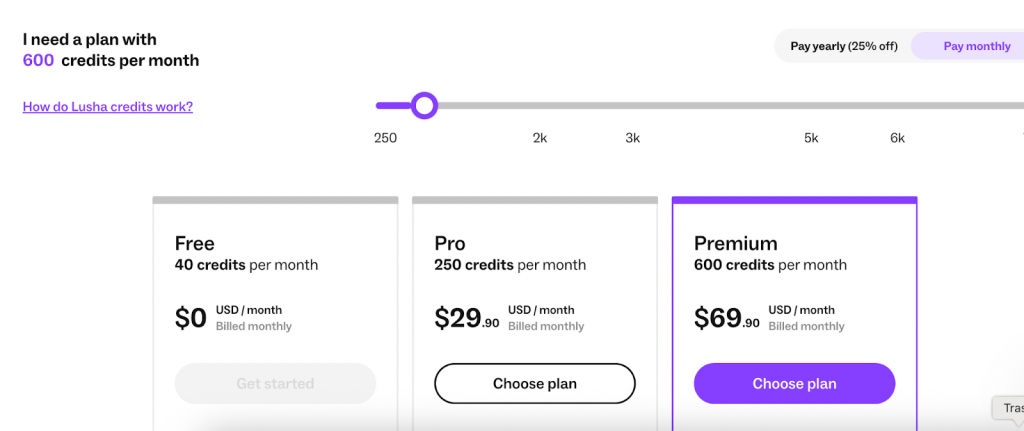
For teams that rely on occasional enrichment, this model can work. Lusha’s free and paid plans provide a defined number of credits, with emails and phone numbers unlocked incrementally before contacts are passed into a separate CRM and email tool. As outbound outreach becomes more frequent, however, this separation often adds overhead and slows execution.
Nimble takes a more integrated approach. As a Lusha alternative, it combines sales prospecting, CRM, outreach, and automation in a single system, allowing teams to move from discovery to engagement without switching tools. Contact enrichment is available through optional enrichment credits, but those credits are applied directly within the CRM, in the context of active relationships and ongoing outreach.
This distinction is especially relevant for SMBs. Instead of deciding how much data to unlock before a lead ever enters the sales process, teams can enrich contacts as conversations evolve and additional context becomes valuable. Outreach, follow-up, and relationship history remain connected, making it easier to stay consistent as volume increases.
For sales teams that want enrichment to support execution rather than interrupt it, Nimble often emerges as the more practical Lusha alternative. It is not about replacing one data source with another, but about reducing fragmentation and enabling a more cohesive sales motion from prospecting through follow-up.
Nimble vs. Lusha: A Practical Comparison for SMBs
| Feature | Nimble | Lusha |
| Starting Price | $29.90/month (flat-rate CRM) | Free tier (40 credits/month); paid plans from ~$29/month |
| Pricing Model | Subscription-based CRM with optional enrichment credits | Credit-based pricing (emails = 1 credit, phones = 5 credits) |
| Total Stack Cost | ~$25-$30/mo. | Lusha + CRM + Sequencer = ~$150-$250/mo. |
| CRM Included | Yes, unified CRM | No, requires separate CRM |
| Contact Enrichment | CRM-native enrichment | Browser-based enrichment |
| Sales Prospecting | Browser-based lead capture tied to CRM | Browser extension for data access |
| Outbound Outreach | Built-in email sequences and workflows | Requires separate email tool |
| Workflow Continuity | Prospecting → enrichment → outreach in one system | Prospecting and outreach handled in separate tools |
For SMBs looking to simplify sales prospecting and outbound outreach while maintaining flexibility around enrichment, Nimble offers a unified alternative to credit-heavy, data-only tools. That balance is often what makes it the right Lusha alternative as teams grow.
Frequently Asked Questions
Is Nimble a good Lusha alternative for small businesses?
Yes. Nimble is a strong Lusha alternativefor small and mid-sized businesses that want more than standalone contact data. While Lusha focuses on data access through a credit-based model, Nimble combines sales prospecting, CRM, outreach, and automation in one platform. This makes it better suited for SMBs that need a unified system rather than a collection of disconnected tools.
Does Nimble use credits like Lusha?
Nimble offers optional enrichment credits, but they function differently from Lusha’s credit-based pricing. With Lusha, credits are required to unlock contact data before it enters a CRM. With Nimble, enrichment credits are applied within the CRM itself, in context, as relationships develop and outreach requires more accurate data.
How accurate is Nimble’s contact and company data?
Nimble enriches contacts using a combination of social data, business profiles, and verified sources. Because enrichment happens inside the CRM, teams can continuously improve and update records over time rather than relying on static snapshots of data pulled at a single point.
Can Nimble replace both Lusha and a CRM?
For many SMBs, yes. Nimble includes a unified CRM, browser-based sales prospecting, contact enrichment, email sequences, workflows, and reporting. Teams that currently use Lusha alongside a separate CRM and email tool often consolidate their stack by switching to Nimble.
Does Nimble support outbound outreach and email sequences?
Yes. Nimble includes built-in email marketing and automated sequences for outbound outreach. Contacts captured through Nimble Prospector or inbound web forms can be enrolled directly into email sequences, assigned tasks, or routed through workflows without switching tools.