

Last updated:
When you’re sending outreach emails, newsletters, or marketing campaigns, the domain you send from plays a bigger role than most people realize. It affects your deliverability, how mailbox providers treat your messages, and whether your emails reach the inbox or get filtered out.
Many small businesses start by sending from a personal Gmail or Outlook address because it’s simple. But as soon as you begin sending to larger lists or running campaigns, a personal domain works against you — and a professional domain becomes essential.
This post breaks down the difference between personal and professional email domains, why it matters, and how to set yourself up for reliable, scalable sending.
What Is a Personal Email Domain?
A personal email domain is any address that ends in something like @gmail.com, @outlook.com, @hotmail.com, or @yahoo.com. These domains belong to major mailbox providers, not to your business, which means you’re sending under their rules and within their limitations.
For everyday, one-on-one communication, personal email addresses work perfectly fine. But the moment you try to use them for campaigns or outreach, their restrictions become a problem. Providers like Gmail and Outlook cap the number of emails you can send each day, often around a few hundred. If you push beyond that, your messages may be throttled, delayed, or blocked entirely.
Personal domains also come with higher spam risk. Commercial emails sent from them are more likely to be filtered or deprioritized because consumer inboxes weren’t built for marketing activity. You also can’t set up SPF, DKIM, or DMARC on these domains — essential authentication protocols that help prove your message is legitimate. Without them, deliverability suffers, trust drops, and your account is more likely to trigger “unusual activity” warnings that can temporarily lock you out.
In short, personal domains are fine for individual communication, but they’re not reliable for any kind of scaled sending.
What Is a Professional Email Domain?
A professional email domain is tied directly to your business — for example, @yourcompany.com or a subdomain like @mail.yourcompany.com. Unlike personal domains, you own and control these addresses. You decide how they’re authenticated, how they’re branded, and how they’re used.
This level of control makes a significant difference. A professional domain allows you to set up SPF, DKIM, and DMARC, which help inbox providers verify that your emails are legitimate. As your domain builds a positive reputation over time, your deliverability improves and your messages are more likely to land in the inbox.
Professional domains also don’t come with the daily sending limits imposed by Gmail or Outlook personal accounts. They inspire more trust because they reflect your brand directly, and they meet the authentication and compliance standards now required by providers like Google and Yahoo for bulk or commercial email.
If your business plans to send newsletters, campaigns, or any form of scaled outreach, using a professional domain isn’t just a best practice — it’s the only way to ensure consistent deliverability and long-term sending success.
Free Guide
The ABCs of CRM
A Beginner's Guide to Understanding &
Using a CRM
Download Free
You’re All Set!
DownloadGet the most out of this guide by starting your free 14-day trial of Nimble today.

Why Personal Domains Fail for
Outreach and Campaigns
Even strong, well-written emails struggle when they’re sent from the wrong infrastructure. Personal Gmail or Outlook accounts simply aren’t built for commercial or high-volume sending, which becomes obvious once a business begins scaling its outreach.
Consider a small consulting firm sending 600 outreach emails using a @gmail.com address. The first few hundred messages are delivered, but the rest start getting delayed because Gmail detects bulk activity and begins throttling the send.
Throttling is when a mailbox provider slows down or temporarily blocks email delivery because it believes the sender is exceeding acceptable limits. For personal accounts, these limits are extremely low — often just a few hundred messages per day.
As a result, some emails go out hours late, some never leave the outbox, and some land directly in spam. Soon after, the account is flagged for “unusual activity,” reducing its sending ability even further. The business sees open rates drop, replies slow down, and outreach stalls — not because the message was wrong, but because the infrastructure couldn’t support the volume.
This is why personal domains consistently fail for marketing or sales outreach. They have low daily caps, unpredictable throttling, higher spam filtering, and no way to authenticate your domain. As volume grows, these issues compound and make it difficult to maintain steady, reliable communication with prospects or customers.

Why Professional Domains Improve Deliverability
Professional domains solve these problems because they’re built for business communication and give you full control over the sending environment.
Let’s return to the consulting firm example — but this time, they’re sending from @theircompany.com. With a professional domain, they can properly authenticate their messages using SPF, DKIM, and DMARC, which signals to inbox providers that the email is legitimate. Because the domain is business-owned and authenticated, inbox providers treat bulk sending differently.
Professional sending infrastructure can handle thousands of emails at once because any throttling that happens is part of a normal, controlled delivery process — not a penalty or warning. Instead of blocking or delaying emails unpredictably, the mail server manages the volume intelligently to ensure steady, safe delivery. This is exactly how email service providers, CRMs, and marketing platforms reliably send large campaigns.
The result is consistent inbox placement, higher trust, and far better engagement. As the domain builds a positive sender reputation over time, outreach becomes more predictable and scalable.
With a professional domain, businesses aren’t fighting against consumer-mailbox limits. They’re sending from infrastructure designed for growth, supported by proper authentication, reputation management, and sending practices that inbox providers recognize and trust.
How Nimble Supports Both Personal and Professional Sending
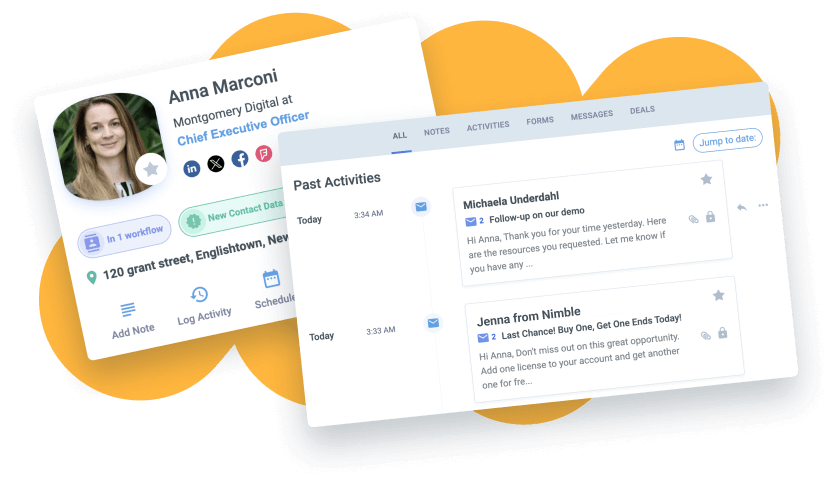
Nimble gives small businesses the flexibility to manage all their communication in one place. You can connect your personal Gmail or Outlook accounts for everyday one-to-one emails, and you can also connect your professional domain for campaigns, newsletters, and higher-volume outreach. Everything — whether personal or campaign-based — is logged back to the contact record so you always have a complete view of conversations and engagement.
This makes Nimble a single, streamlined hub for all your communication, from individual follow-ups to full marketing campaigns.
Nimble’s Email Marketing Tool: Professional-Domain Sending Built for Deliverability
When you connect your professional domain to Nimble, you gain access to authenticated sending that supports unlimited campaigns and outreach sequences. Nimble configures SPF and DKIM authentication for you, helping you build a strong sender reputation and improve inbox placement over time.
Nimble’s email marketing tool also provides email templates for repeatable outreach and a built-in bounce checker that scans your list before sending, identifying invalid or risky addresses. This reduces hard bounces, protects your domain, and keeps your deliverability healthy as your volume grows.
Saunders Real Estate — a commercial real-estate advisory firm — used Nimble to unify communication, track relationships, and streamline email outreach across their team. With Gmail connected to Nimble and all engagement centralized in one place, they doubled their deal momentum and built a more consistent, scalable outreach process.
Looking to Improve Deliverability and Scale Your Outreach?
Nimble helps small businesses move beyond the limitations of personal inboxes by offering authenticated professional-domain sending, unlimited campaigns, and built-in list quality tools. But it’s more than an email marketing tool — Nimble is also a full CRM, so your campaigns, contact data, communication history, and follow-ups all stay connected.
Whether you’re nurturing leads, managing relationships, or running larger outreach efforts, Nimble centralizes your communication and gives you the infrastructure you need to send more reliably, maintain cleaner data, and scale your outreach with confidence. If you want a simple, unified approach to email marketing and outreach, Nimble offers the tools to support your next step. Get started with Nimble’s Email Marketing today!