


Last updated:
Most small businesses don’t fail because the idea was wrong. They fail because the execution never became a system.
The owner who built the business on referrals and relationships hits a ceiling when word of mouth slows down. The team that was scrappy and fast at 5 people becomes disorganized at 15. The product that sold itself in year one needs actual marketing in year three. Growth exposes every gap you papered over when things were simpler.
This guide covers the full picture of small business growth — planning, tools, lead generation, follow-up, customer retention, and the metrics that tell you whether any of it is working. Not theory. The actual decisions and systems that determine whether a small business scales or stalls.
What small business growth actually looks like
Growth gets talked about like it’s one thing. It isn’t. Revenue growth, customer growth, team growth, and margin growth are four different problems that sometimes require contradictory solutions. Adding headcount grows your team but compresses margin. Running discounts grows customers but trains them to wait for deals. Growing revenue by taking on every client regardless of fit exhausts the team and kills culture.
Before chasing any growth metric, the question is: which kind of growth do you actually need right now, and what does sustainable look like for your business specifically?
For most small businesses, the honest answer is: more of the right customers, retained longer, with a process that doesn’t depend entirely on the founder to function. That’s the growth problem worth solving. Everything else follows from it.
Start with a business plan
Growth without direction is just chaos at higher volume. A business plan — even a lightweight one — forces you to articulate who you serve, what problem you solve, how you make money, and what success looks like in 12 months. That clarity is what makes every subsequent decision faster.
Most small business owners skip formal planning because it feels like busywork. The businesses that skip it tend to react to whatever comes in rather than building toward anything specific.
Growth Playbook
The Small Business Growth Playbook
Practical plays to sell, market, and grow — on the relationships you already have.
- Build a pipeline that fills itself
- Turn one-time buyers into regulars
- Follow up without the busywork
- Grow without adding headcount
Download Free
You’re All Set!
DownloadGet the most out of this guide by starting your free 14-day trial of Nimble today.
What a small business plan needs to cover
A useful business plan doesn’t need to be 40 pages. It needs to answer six questions:
- Who is the customer and what do they need?
- What is the product or service, and why is it better than alternatives?
- How does the business make money — pricing, margins, revenue model?
- How will customers find and buy from you?
- What does the operation look like — team, tools, capacity?
- What are the financial targets, and how will you know you’re on track?
Everything else is detail. Get those six answers documented and revisit them quarterly.
Business plans by industry
The fundamentals are the same across industries, but execution varies significantly. A bakery business plan looks different from a real estate agency’s. The financial model, customer acquisition approach, and operational constraints are all different. For industry-specific examples:
- Business plan examples for a bakery
- Business plan examples for a real estate agency
- Marketing plan examples for a hair salon
- Marketing plan examples for a beauty salon
Build your tech stack intentionally
Most small businesses accumulate tools the same way they accumulate clutter — one at a time, each one solving an immediate problem, until you’re paying for 8 subscriptions that don’t talk to each other and your team spends half its time switching between them.
The average SMB tech stack has significant overlap, redundancy, and tools that nobody actually uses consistently. That has a real cost — not just in subscription fees, but in the time lost to context switching, the data fragmentation across platforms, and the operational complexity that slows everything down.
The tools a small business actually needs
At a minimum, a small business needs:
- A CRM to manage contacts, pipeline, and follow-up
- An email tool — ideally built into the CRM rather than bolted on separately
- A calendar and scheduling tool
- A project or task management tool for internal work
- A communication tool for the team
Everything beyond these five categories should justify its existence. If a tool isn’t actively used by the people who were supposed to use it, it’s not solving a problem — it’s adding friction.
For a detailed look at how SMB tool sprawl happens and what it actually costs, see the hidden cost of the SMB tech stack. For a broader roundup of organizational tools worth considering, see the top organizational tools for small businesses.
What to look for in a small business CRM
The CRM is the most important tool in the stack because it touches every part of the business — sales, marketing, customer success, and operations. Getting it wrong is expensive. Getting it right compounds over time.
For small businesses, the right CRM is one the team will actually use. Enterprise CRMs with complex configuration requirements and steep learning curves get abandoned within three months. The features that matter at small business scale: contact management, pipeline visibility, email integration, follow-up reminders, and reporting that doesn’t require a data analyst to interpret.
For a breakdown of what to look for and what questions to ask before buying, see CRM for beginners and what CRM actually costs for small businesses.
Get your CRM working for you
A CRM that gets set up and then used as a glorified address book isn’t a CRM — it’s an expensive contact list. The businesses that grow with their CRM use it as an operating system: every contact is in there, every interaction is logged, every follow-up is scheduled, and the pipeline reflects reality.
Getting there takes discipline upfront and habit over time. Most teams that fail with CRM don’t fail because the software is wrong — they fail because adoption was never enforced and data entry became optional.
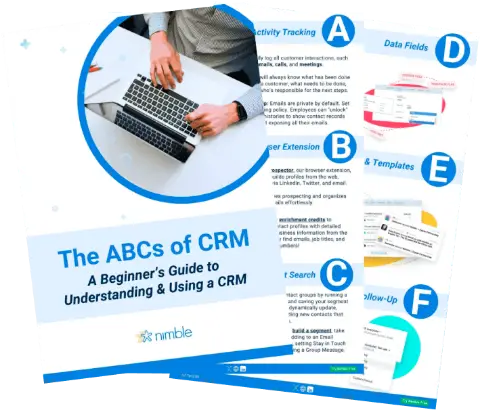
Free Guide
The ABCs of CRM
A Beginner's Guide to Understanding &
Using a CRM
Download Free
You’re All Set!
DownloadGet the most out of this guide by starting your free 14-day trial of Nimble today.
The basics that have to be non-negotiable
Before anything advanced, three things need to be true:
- Every contact goes into the CRM — not some contacts, all of them
- Every significant interaction gets logged — calls, emails, meetings
- Every open deal has a next action and a date attached to it
These three habits, done consistently, make everything else possible. Pipeline reviews become meaningful. Forecasting becomes possible. Handoffs between team members stop the loss of information.
Growth Playbook
The Small Business Growth Playbook
Practical plays to sell, market, and grow — on the relationships you already have.
- Build a pipeline that fills itself
- Turn one-time buyers into regulars
- Follow up without the busywork
- Grow without adding headcount
Download Free
You’re All Set!
DownloadGet the most out of this guide by starting your free 14-day trial of Nimble today.
Using your CRM to drive sales results
A well-run CRM doesn’t just track what happened — it drives what happens next. For practical guidance on how small businesses actually use CRM to hit sales targets, see 10 ways small businesses use CRM to hit their sales goals. For pipeline-specific best practices, see pipeline management best practices for small business. For contact organization, see CRM best practices for contact management.
Attract and capture leads consistently
Referrals and word of mouth get most small businesses started. They rarely get a small business to scale. At some point, growth requires a repeatable system for attracting people who don’t already know you and converting their attention into a contact you can follow up with.
The channels that work best for small businesses are search (organic and paid), LinkedIn outreach, content, and referral programs built deliberately rather than left to chance. Most businesses don’t need all of these — they need two or three working well.
Prospecting: working outbound intentionally
Outbound prospecting is the most controllable lead source a small business has. You define the ideal customer, build the list, reach out, and follow up. It doesn’t depend on an algorithm, a referral, or a piece of content going viral.
The businesses that do this well have a defined prospect profile, a tool for building lists, and a CRM that makes outreach trackable. For the strategy behind it, see smart prospecting strategies for small businesses.
Paid social: Facebook ads for small business
Facebook and Instagram ads remain one of the most accessible paid channels for small businesses — lower floor than Google Ads, strong targeting by interest and behavior, and formats that work for both awareness and retargeting. The businesses that waste money on Facebook ads target too broadly, run one ad, and measure nothing. The ones that make it work start narrow, test creative, and optimize toward actual leads or purchases — not impressions.
For the strategies that actually move the needle, see Facebook ads strategies for small businesses.
Lead capture: turning attention into a contact
Getting attention is step one. Capturing it is step two — and most small businesses are bad at step two. A web form buried in the footer converts almost no one. High-converting capture happens at the right moment: on a pricing page, at the end of a valuable piece of content, or triggered by behavior that signals intent.
For a deeper look at the tools and approaches that work, see the best CRMs for lead capture.
Follow up until it closes
This is the section most small business owners skip because they think they already do this. They don’t.
The data is consistent across industries: most deals require five to eight touchpoints to close. Most small business salespeople follow up once or twice and then stop. Not because they don’t care — because there’s no system telling them who needs a follow-up today, and manual tracking across a pipeline of 30 open deals is genuinely hard to maintain.
The follow-up gap is where growth dies
Leads that go cold don’t disappear. They buy from whoever follows up. The company that sent four emails and made two calls will close the deal that another company lost after one email and a shrug.
The fix isn’t working harder — it’s automating the middle. The first touchpoint and the last should be personal. Everything in between can be templated, scheduled, and triggered automatically so that follow-up happens on schedule, whether or not the salesperson remembered.
For context on how many touchpoints actually close deals, see how many touchpoints it takes to close a sale. For the practical mechanics of building a follow-up system, see how to automate follow-ups in CRM for small business.
Retain the customers you have
Acquisition gets the attention. Retention is where the money actually is.
Replacing a churned customer costs five times more than keeping one. For subscription businesses, the math is even more punishing — a customer who churns after month two never paid back their acquisition cost. For service businesses, a lost client means finding a replacement who takes months to onboard and trusts you the same way.
The businesses that grow fastest aren’t always the ones with the best marketing. They’re the ones with the lowest churn — because every customer they keep is one they don’t have to replace.
Keeping contact data accurate and organized
Retention starts with knowing who your customers are and staying connected to them over time. That sounds obvious but most small businesses have customer data scattered across email threads, spreadsheets, and half-updated CRM records. When a customer reaches out, the team is starting from scratch instead of picking up where they left off.
Organized, enriched contact records — with interaction history, preferences, and context — make every customer conversation better. For the best practices, see how to store and organize customer details in a CRM.
Growth Playbook
The Small Business Growth Playbook
Practical plays to sell, market, and grow — on the relationships you already have.
- Build a pipeline that fills itself
- Turn one-time buyers into regulars
- Follow up without the busywork
- Grow without adding headcount
Download Free
You’re All Set!
DownloadGet the most out of this guide by starting your free 14-day trial of Nimble today.
Segmentation: not every customer is the same
Your highest-value customers have different needs than your newest ones. Customers who bought one product behave differently from those who use three. Treating every customer the same — same emails, same check-ins, same offers — is a missed opportunity at best and a retention problem at worst.
Contact segmentation lets you communicate with customers based on what’s actually true about them. For the practical approach, see contact segmentation best practices for small business.
Using analytics to spot problems early
Churn rarely happens suddenly. There are almost always signals — declining engagement, fewer logins, slower response times, and support tickets that didn’t get resolved. The businesses that catch these signals early can intervene. The ones that don’t find out when the cancellation email arrives.
CRM analytics don’t need to be complex to be useful. A weekly look at engagement by segment, deal velocity trends, and customer activity flags is usually enough to catch the problems before they become losses. For guidance on setting this up, see CRM analytics best practices for small business.
Measure what matters
Most small businesses either measure nothing or measure everything — and both are useless. Measuring nothing means you’re flying blind. Measuring 30 metrics means you can’t tell the signal from the noise.
The metrics that actually matter for small business growth:
- Monthly recurring revenue (MRR) or monthly revenue — is the business growing?
- Customer acquisition cost (CAC) — what does it cost to get a new customer, by channel?
- Customer lifetime value (LTV) — how much is each customer worth over the full relationship?
- LTV:CAC ratio — the single most important growth health metric; should be 3:1 or higher
- Churn rate — what percentage of customers are leaving each month?
- Lead-to-close rate — of all leads that come in, how many become customers?
- Sales cycle length — how long does it take from first contact to closed deal?
Start with these seven. Once you can report on them weekly without effort, add nuance. Before that, adding more metrics just creates confusion.
Common growth mistakes small businesses make
- Growing headcount before growing systems. Hiring more people into a broken process doesn’t fix the process — it scales the breakage. Document and stabilize before you add people.
- Optimizing for revenue instead of margin. A business doing $2M at 10% margin is less healthy than one doing $800K at 40%. Revenue is vanity. Margin is the number that determines whether growth is sustainable.
- Ignoring the customers they have. Every dollar spent acquiring a new customer while an existing one quietly churns is partially wasted. Fix retention before pouring more into acquisition.
- Treating every lead the same. Not all leads are worth the same time. A prospect who fits your ideal customer profile perfectly should get more follow-up than one who doesn’t. Segment and prioritize.
- Building on one channel. Businesses built entirely on referrals are fragile. Businesses built entirely on paid ads are fragile. Diversify acquisition before you have to.
- Skipping the CRM. Every sales conversation, every customer relationship, every follow-up that lives in someone’s head or inbox is a liability. When that person leaves or gets overwhelmed, the information goes with them. A CRM is institutional memory.
- Measuring activity instead of outcomes. Calls made, emails sent, posts published — these are inputs. Leads generated, deals closed, customers retained — these are outcomes. Measure outcomes.
Building a growth system, not just running tactics
Tactics get you started. Systems get you to scale.
A tactic is running a Facebook ad campaign this month. A system is a defined process for testing, evaluating, and iterating on paid acquisition every quarter. A tactic is following up with a hot lead. A system is a CRM-driven cadence that ensures every lead gets followed up with, on schedule, regardless of who’s having a busy week.
The difference between small businesses that plateau and those that grow is almost never the quality of the ideas. It’s the consistency of execution — and consistency requires systems, not willpower.
Build the plan. Choose the tools deliberately. Get the CRM working. Create a repeatable process for lead generation and follow-up. Measure what matters. Then invest in what’s working.
That’s not a complicated formula. It’s just one of the most common businesses never fully executed.
- Business Plan Examples for a Bakery
- Business Plan Examples for a Real Estate Agency
- The Hidden Cost of Your SMB Tech Stack
- Top Organizational Tools for Small Businesses
- What CRM Actually Costs for Small Businesses
- Smart Prospecting Strategies for Small Businesses
- Facebook Ads Strategies for Small Businesses
- How Many Touchpoints Does It Take to Close a Sale?
- How to Automate Follow-Ups in CRM for Small Business
- Pipeline Management Best Practices for Small Business
- Contact Segmentation Best Practices for Small Business
- CRM Analytics Best Practices for Small Business
- 10 Ways Small Businesses Use CRM to Hit Their Sales Goals
- Best CRMs for Lead Capture
- How to Store and Organize Customer Details in a CRM