

Whether you’re a solo consultant, a sales-savvy small business owner, or part of a growing team, your CRM is only as good as the information you feed into it. That’s where CRM web forms come in.
Web forms help you capture contacts, collect key info, and trigger follow-ups — all without copying and pasting data across tools.
When used correctly, they’re not just lead capture forms —they’re your frontline for growth, automation, and staying organized.
Here are 14 web form use cases that show what’s possible — and how you can get more out of your CRM starting today.
1. Capture Website Leads Automatically
Most businesses have a “Contact Us” form sitting on their site… and then what?
The submissions are sent to someone’s inbox, may get flagged, and sometimes forwarded to sales, only to be forgotten entirely.
Instead, connect your web form to your CRM.
Every new lead gets added as a contact, tagged, and assigned a follow-up task instantly.
No copy-pasting, no missed messages, no dropped opportunities.
2. Offer a Free Resource or Lead Magnet
You’ve got a valuable freebie — a guide, checklist, or template — and a form to collect signups.
But without automation, what usually happens?
You end up manually pulling the responses, importing them into your CRM, tagging contacts, and trying to remember who to follow up with (and when). It’s clunky and easy to drop the ball.
With Nimble’s web forms add-on, you can:
- Instantly create a new contact in Nimble
- Automatically tag them based on what they downloaded
- Enroll them in an email sequence for timely follow-up
Drop them into a workflow so you can visualize exactly where they are in your sales or nurture process
3. Let Visitors Request a Demo or Consultation
You want leads, but you don’t want to spend your day chasing low-fit inquiries.
With a smart web form, you can collect key details upfront — like Company Size, Industry, Budget Range, or What They’re Looking For.
This info helps you quickly spot high-intent leads — and filter out ones that aren’t a fit.
With Nimble, you can go one step further:
- Route the lead to the right teammate automatically
- Drop them into a deal pipeline with the right tags and stage
- Even trigger a follow-up task or email sequence tailored to their interest
You’re not just collecting leads — you’re qualifying and organizing them from the first click.
4. Collect Service Inquiries or Quote Requests
If you offer custom services, you know how much time gets wasted going back and forth just to understand what a potential client needs.
With a well-built web form, you can collect important project details upfront, such as:
- Project type or scope
- Timeline or launch date
- Budget range
- Key goals or challenges
Instead of just capturing a name and email, you’re gathering context that helps you qualify and prepare.
In Nimble, this info becomes part of the contact record, so when you or your team follow up, you’re not starting from scratch. You can also:
- Auto-tag the contact based on service type
- Assign it to a rep
- Drop it straight into your sales pipeline or workflow
Less back-and-forth. More qualified conversations.
5. Build Your Newsletter List
A “Join our newsletter” form might seem basic, but when connected to your CRM, it becomes a powerful list-building and segmentation tool.
Instead of just collecting emails in a generic list, you can:
- Automatically tag each subscriber (e.g., “Newsletter,” “Top of Funnel”)
- Add them to a group for easy filtering later
- Enroll them in an email sequence that introduces your brand or offers
- Track who’s engaging — right inside their contact record
This setup makes it easy to send targeted campaigns based on interest, activity, or lifecycle stage, without needing a separate email tool.
It’s not just a signup form. It’s the start of a relationship you can nurture inside Nimble.
6. Register Attendees for Events or Webinars
Whether you’re hosting a webinar, product demo, or live Q&A, managing signups manually can get messy fast.
With a CRM-connected web form, you can:
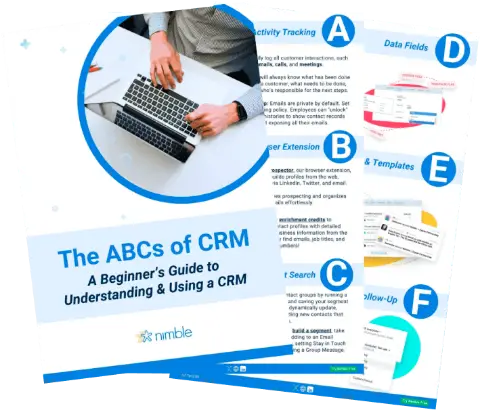
Free Guide
The ABCs of CRM
A Beginner's Guide to Understanding &
Using a CRM
Download Free
You’re All Set!
DownloadGet the most out of this guide by starting your free 14-day trial of Nimble today.
- Collect clean, structured data like name, email, job title, and company
- Automatically tag registrants (e.g., “Demo Attendee” or “Webinar: July 2025”)
- Add them to a follow-up sequence or task list right after the event
- Track who attended, who engaged, and who needs a personal follow-up
All that data lives in one place — your CRM — so your team can easily personalize outreach and continue the conversation after the event.
No spreadsheets. No post-event chaos. Just warm leads, well managed.
7. Collect Referrals from Happy Customers
Referrals are gold, but they don’t happen by accident. Make it easy for your happiest clients to refer others by sending them a referral form link they can fill out in seconds.
You can share the form in:
- Post-purchase thank-you emails
- Client check-in messages
- Automated follow-ups after successful projects
With Nimble, each referral submission can:
- Automatically create a new contact
- Be tagged as “Referred Lead” or by the original customer’s name
- Trigger a follow-up task or workflow to reach out quickly
It’s a simple, scalable way to turn customer satisfaction into new business, without relying on word of mouth alone.
8. Run Quick Surveys or Feedback Requests
You don’t always need a 10-question survey to understand how your clients are feeling. Sometimes, a single question is enough to surface issues or opportunities.
Use a simple web form to ask something like:
“On a scale from 1 to 10, how satisfied are you with our service so far?”
Then, let automation do the heavy lifting:
- Responses log directly into the contact’s CRM record
- You can tag responses (e.g., “Promoter,” “Neutral,” “Needs Attention”)
- Automatically trigger follow-up tasks or alert a teammate for anything below a certain score
This gives your team a fast, lightweight way to check in after onboarding, a support interaction, or project completion — and ensures no red flags get missed.
A one-question form can start a conversation, recover a relationship, or spark a testimonial — all without leaving Nimble.
9. Simplify New Client Onboarding
The back-and-forth that usually happens at the start of a client relationship — “Can you send over your info?” “What are your goals?” “Who’s the main contact?” — can drag out the process and create delays.
Instead, send a client intake form that collects everything up front:
- Contact details
- Company background
- Key goals and priorities
- Timelines or expectations
Once the form is submitted, Nimble can:
- Store the info directly in the client’s CRM record
- Automatically assign onboarding tasks to your team
- Place the client into a workflow board so you can track their progress through each onboarding step
It keeps your team aligned, your clients informed, and your process consistent, without all the email chasing.
10. Manage Support or Contact Requests
“Contact us” forms often end up in a shared inbox, where responses can slip through the cracks, especially when multiple types of requests are coming in (support, sales, billing, partnerships, etc.).
By connecting your general inquiry form to your CRM, you can turn each submission into an organized, actionable item:
- Use dropdowns or checkboxes to let people indicate the type of inquiry (e.g., Support, Sales, Other)
- Apply tags like “Support Request” or “New Opportunity” based on their selection
- Automatically route the inquiry to the right team member or assign a follow-up task
- Capture all communication history within the contact record for future reference
You can also track response times and resolution steps using workflows, giving your team visibility and accountability without needing a separate ticketing tool.
It’s a lightweight way to streamline your inbound messages and stay responsive, even as your business scales.
11. Let Contacts Update Their Info
Over time, people change roles, companies, and even email addresses — and outdated CRM data can quietly hurt your outreach efforts. Emails bounce, messages go ignored, and segmentation becomes less accurate.
Instead of chasing updates manually, send contacts a short, user-friendly form where they can:
- Update their email address, job title, or phone number
- Select communication preferences (e.g., how often they want to hear from you)
- Share new company info or note a change in responsibilities
You can share the form link in:
- Re-engagement email campaigns
- Quarterly check-ins
- Newsletters or account update requests
When submitted, the new info flows directly into their Nimble contact record, keeping your data clean and your communication relevant, without lifting a finger.
It’s a small touch that makes a big difference in maintaining strong, up-to-date relationships.
12. Log New Leads at Events
Business cards are easy to lose. Notes on your phone? Easy to forget. And spreadsheets? Nobody updates them after a long day at a conference.
Instead, open a simple lead capture form on your phone or tablet and enter contact details as you go — or have team members do it on the spot.
Whether you’re:
- Networking at an industry event
- Meeting prospects at a trade show booth
- Hosting a workshop or speaking engagement
…you can quickly record:
- Name, email, and company
- Notes about the conversation
- Interest level or next steps
Every entry goes straight into Nimble as a new contact, where it can be tagged, assigned, and followed up with automatically. You can also drop each one into a workflow board for post-event outreach and tracking.
It’s faster than typing emails later, and way more effective than a pile of business cards you’ll never sort through.
13. Collect Partner or Vendor Applications
If your business works with resellers, affiliates, vendors, or collaborators, keeping their inquiries organized can be a challenge, especially when they all come through the same generic inbox.
Instead, create a dedicated Partner/Vendor Interest Form where prospects can share relevant info such as:
- Type of partnership they’re interested in (e.g., affiliate, integration, co-marketing)
- Company name and website
- Their audience, services, or product offering
- Why do they want to partner with you?
When someone submits the form, Nimble can:
- Automatically tag them as a “Partner Lead” or “Vendor Prospect”
- Route the inquiry to the right internal contact
- Assign a follow-up task or add them to a partner evaluation workflow
This not only keeps your pipeline clean, but it also helps your team prioritize high-potential partnerships and maintain a professional response process.
It’s a scalable way to grow your partner ecosystem without letting good opportunities slip through the cracks.
14. Track Internal Submissions or Checklists
CRM web forms aren’t just for capturing external leads — they can streamline your internal operations too. Instead of relying on Slack messages, scattered docs, or hallway conversations, use forms to standardize how your team submits key info.
Here are a few practical examples:
- Team onboarding checklists – Have new hires submit when they complete certain tasks (e.g., “Set up email signature,” “Watched CRM walkthrough video”)
- Marketing or campaign requests – Let team members request new email campaigns, social posts, or landing pages using a centralized form
- Training completions or certifications – Collect confirmations and quiz results that get logged to the team member’s CRM record
- Process feedback or improvement suggestions – Gather input in a structured way and tag submissions for follow-up
In Nimble, each form submission becomes a record you can assign, tag, and track — all within a workflow board if needed — so nothing gets lost in the shuffle.
It keeps your internal processes just as organized as your sales pipeline — and saves your team time and confusion.
Final Thoughts
Web forms aren’t just boxes to collect names and emails. When they feed directly into your CRM, they become a launchpad for smarter workflows, faster follow-ups, and more meaningful relationships.
If you’re already using Nimble, our native web form add-on makes all of this possible — no coding, no Zapier, no juggling tools.
Ready to start capturing leads and triggering automations?
Explore Nimble Web Forms