

Figuring out how to choose a CRM is one of the highest-stakes decisions a small business can make — and most people get it wrong. Not because they don’t care, but because they ask the wrong questions.
They compare pricing pages, book a demo, and sign up before they’ve tested whether their team will actually use the thing.
(And if you’ve seen the G2 CRM grid lately, it looks like someone zoomed out on a city from space. There are hundreds of options.

You’ve probably been burned before. Maybe you paid for a CRM your team refused to touch.
Maybe you imported 4,000 contacts and realized — three months in — that the tool couldn’t do what you needed. Maybe you’re still running your entire sales operation out of a spreadsheet, telling yourself you’ll “set something up soon.”
Here’s the good news: most CRM regret is completely avoidable.
These 14 questions cover everything — ease of use, integrations, pricing, support, and the red flags vendors hope you never ask about.
Ease of Use: The First Test When Choosing a CRM
The #1 reason CRMs fail isn’t price. It’s adoption. A tool your sales team hates using is worse than no tool at all — because at least with no tool, you know what you’re working with. Ask these questions before you ever get to pricing.
1. How long does it take to get a new user up and running?
Why it matters: A CRM that takes weeks to learn creates friction from day one. Most small teams don’t have the time — or the patience — for a 40-hour onboarding program.
What to look for: Look for tools with a guided setup, pre-built templates, and a clean interface that doesn’t require a manual. Ask the vendor: ‘Can I show a new hire how to use this in under an hour?’
| How Nimble handles this: Nimble is built for non-technical teams. Most users are fully set up and logging contacts within the same day they sign up. No IT department required. |
2. Does it work where my team already works?
Why it matters: If your reps have to leave Gmail, switch tabs, or remember to log into a separate platform — they won’t. Adoption lives and dies by convenience.
What to look for: Ask if the CRM has a browser extension, Gmail/Outlook integration, or a mobile app your team will actually open. The best CRMs reduce the number of steps to log a conversation, not add to them.
| How Nimble handles this: Nimble lives inside your inbox. The browser extension pulls up contact details wherever you are — Gmail, LinkedIn, any website. Your team logs notes without breaking their flow. |
3. Can I customize it without calling a developer?
Why it matters: Every business tracks different things. A realtor tracking listing stages needs different fields than a SaaS founder tracking trial-to-paid conversions. Rigid systems create workarounds — and workarounds create chaos.
What to look for: Ask how easy it is to add custom fields, rename pipeline stages, and adjust views without touching code or submitting a support ticket.
| How Nimble handles this: In Nimble, you can add custom fields, build custom pipelines, and tag contacts however you want — all from the settings panel. No code. No consultant. |
Integrations
A CRM that doesn’t talk to your other tools is just an expensive contact list. Before you commit to anything, map out the software your team uses every day — and make sure your CRM speaks the same language.
4. Does it integrate with the tools I already use?
Why it matters: You’re probably using email, a calendar, maybe a marketing tool, maybe QuickBooks. Adding a CRM that doesn’t connect to any of those means you’re doubling your data entry.
What to look for: Get a specific list of native integrations (not just ‘we work with Zapier’). Native integrations are faster, more reliable, and don’t require a third-party subscription to maintain.
| How Nimble handles this: Nimble integrates natively with Google Workspace, Microsoft 365, and hundreds more. And yes — Zapier too, if you need it. |
5. How does it handle social media and LinkedIn?
Why it matters: For SMBs, solopreneurs, and realtors especially, a lot of relationship-building happens on LinkedIn. If your CRM can’t pull in that context, you’re missing half the picture.
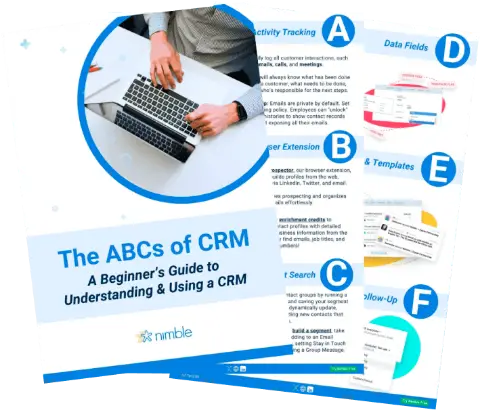
Free Guide
The ABCs of CRM
A Beginner's Guide to Understanding &
Using a CRM
Download Free
You’re All Set!
DownloadGet the most out of this guide by starting your free 14-day trial of Nimble today.
What to look for: Ask if the CRM enriches contacts automatically from social profiles, and whether it can be used on LinkedIn.
| How Nimble handles this: Nimble was built with social selling in mind. It enriches contact profiles automatically using publicly available data — so when you look someone up, you already know where they work, their title, and how you’re connected. |
6. What happens if I need an integration you don’t have yet?
Why it matters: No CRM connects to everything. What matters is what happens when you hit a gap — is there a roadmap? An API? A responsive product team?
What to look for: Ask about their API access, their integration roadmap, and whether feature requests actually get built. A vendor that can’t answer this question is a red flag.
| How Nimble handles this: Nimble offers an open API for custom integrations and an active product roadmap. The team is known for being responsive to customer requests — especially from power users. |
Pricing and Scaling
The sticker price is rarely the real price. CRM costs have a way of creeping up — extra seats, premium features locked behind higher tiers, migration fees when you outgrow the plan you started on. These questions protect you.
7. What does it actually cost at my team size — and double that?
Why it matters: A CRM that’s $25/month for two users can become $300/month by the time you add your whole team and turn on the features you actually need. Model out the real cost now, not later.
What to look for: Ask for a full breakdown at your current size and projected size in 12-24 months. Include storage limits, email sends, and any add-ons you’d realistically use.
| How Nimble handles this: Nimble’s pricing is flat and transparent. You pay per seat, and every user gets the same feature set — no tiered plans that hide the good stuff behind enterprise pricing. |
8. Are there limits that will slow me down?
Why it matters: Some CRMs cap the number of contacts, emails per month, pipeline stages, or reports at the lower tiers. You won’t notice until you hit the wall.
What to look for: Ask specifically about: contact limits, email send limits, number of pipelines, custom field limits, and storage. If the answer is vague, push harder.
| How Nimble handles this: Nimble doesn’t penalize you for growing. You get access to many features that are usually hidden by expensive tiers like sequences and you can build as many pipelines and custom fields as your business needs. |
9. Can I export my data whenever I want?
Why it matters: Treveiwhis is one of the most people forget to ask — until they want to leave. A CRM that holds your data hostage isn’t a vendor. It’s a liability.
What to look for: Make sure you can export a full .CSV of your contacts, deal history, notes, and activity log at any time, with no export fees. It’s your data.
| How Nimble handles this: Nimble lets you export everything, anytime, in clean CSV format. No bureaucratic export request, no fee, no waiting. |
Support and Onboarding
Here’s something most buyers overlook: the quality of support matters more in months two and three than it does on day one. The honeymoon period ends. The technical questions get harder. That’s when you find out whether your vendor actually shows up.
10. What does onboarding actually look like?
Why it matters: A CRM that hands you a PDF and says ‘good luck’ will cost you far more in lost time than the money you saved on a cheaper plan. Onboarding quality varies wildly — and it’s almost never reflected in the price.
What to look for: Ask what’s included: live onboarding call, video library, knowledge base, dedicated onboarding specialist? Ask what happens if you need to re-onboard a new hire six months from now.
| How Nimble handles this: Nimble includes onboarding support with every account — not a chatbot, a real walkthrough. Their knowledge base is deep, and their YouTube channel has step-by-step tutorials for almost every use case. |
11. How fast does support actually respond?
Why it matters: Response time on a Tuesday afternoon is one thing. Response time when your pipeline breaks two hours before a big sales call is another.
What to look for: Ask for real SLA numbers on their support tiers. Ask if live chat is available without upgrading to an enterprise plan. Test their support channel before you buy — seriously, send them a question.
| How Nimble handles this: Nimble’s support team responds quickly via live chat and email. Their response times are consistently well-reviewed, and they’re known for actually solving problems rather than pointing to a FAQ. |
12. Is there a community of other users I can learn from?
Why it matters: Peer communities are underrated. The fastest way to learn any tool is often to ask someone who’s already been through your exact problem.
What to look for: Ask if there’s an active user community, a Facebook group, a Slack channel, or regular webinars. This is especially valuable for small teams without a dedicated ops person.
| How Nimble handles this: Nimble has an active user community and a regular webinar series where real users share how they’ve built their workflows. |
Red Flags to Watch For
Not all of these questions are about what a CRM can do. Some are about who you’re dealing with. These are the warning signs that most buyers only recognize in hindsight.
13. Is the sales process pushing me to commit before I’m ready?
Why it matters: High-pressure tactics — urgency pricing, limited-time discounts, ‘this offer expires Friday’ — are a sign of a vendor that doesn’t trust their product to sell itself. Good software doesn’t need manufactured urgency.
What to look for: A vendor worth trusting will give you a real free trial, let you take the time you need, and answer your questions without a countdown clock.
| How Nimble handles this: Nimble offers a no-credit-card free trial. There’s no sales pressure, no countdown clock. Try it. If it works for you, great. If not, you’ve lost nothing. |
14. Are there real reviews from businesses like mine?
Why it matters: Vendor testimonials are curated. G2, Capterra, and Google reviews are not. Look specifically for reviews from businesses your size, in your industry, with your use case.
What to look for: Search ‘[CRM name] reviews for [your industry]’ before you buy. Pay attention to reviews that mention support quality, ease of migration, and what happened when something went wrong.
| How Nimble handles this: Nimble has thousands of verified reviews from SMB owners, sales teams, realtors, and startup founders. Look up ‘Nimble CRM reviews‘ and read the ones that sound like your business. |
Quick Reference: Your CRM Checklist
Before you sign up for anything, run through this. If a CRM can’t answer ‘yes’ to most of these, keep looking.
| Question | Your CRM’s Answer |
| New user up and running same day? | Yes / No / Partial |
| Works inside Gmail / Outlook? | Yes / No / Partial |
| Customizable without a developer? | Yes / No / Partial |
| Native integrations with your stack? | Yes / No / Partial |
| Handles LinkedIn / social enrichment? | Yes / No / Partial |
| API available for custom integrations? | Yes / No / Partial |
| Pricing is transparent at 2x team size? | Yes / No / Partial |
| No hidden limits on contacts or pipelines? | Yes / No / Partial |
| Full data export available anytime? | Yes / No / Partial |
| Real onboarding support included? | Yes / No / Partial |
| Live chat support without enterprise plan? | Yes / No / Partial |
| Active user community or knowledge base? | Yes / No / Partial |
| No high-pressure sales tactics? | Yes / No / Partial |
| Strong reviews from your industry? | Yes / No / Partial |
The Bottom Line: How to Choose a CRM You Won’t Regret
Choosing a CRM is one of the highest-leverage decisions a small business or startup can make. The right one will tighten your sales process, surface the deals you’d otherwise drop, and give your whole team a shared view of every relationship. The wrong one will sit unused on a bookmark bar while your contacts slowly go stale in a spreadsheet.
Run through these 14 questions with every tool you evaluate. If a vendor gets defensive, vague, or suddenly very busy when you ask about data export or support response times — that’s your answer.
You deserve a CRM that’s as serious about your growth as you are.
| See how Nimble answers all 14 questions. |
| Book a free personalized walkthrough and see exactly how Nimble handles your team’s workflow, integrations, and sales process — no sales pitch, no pressure. |