

Web forms are one of the most powerful lead-generation tools available to modern businesses. They work 24/7, capture intent at the exact moment a visitor is interested, and feed your sales or marketing pipeline with fresh contacts. But collecting form submissions is only half the job. To truly succeed, you need a robust system for CRM follow-up automation that determines what happens next.
Many companies lose a significant percentage of web form leads not because of poor traffic quality, but because follow-up is slow, inconsistent, or completely manual. This is where CRM follow-up automation becomes critical. When configured correctly, automation ensures every web form contact receives timely, relevant, and personalized communication without overwhelming your team.
Below are practical and proven tips for building effective CRM follow-up automation specifically for web form contacts.
Tip 1: Respond Immediately While Intent Is Still Hot
Speed is the single most important factor in web form follow-up. When a user fills out a form, they are actively thinking about a problem, a solution, or a purchase. That moment of intent fades quickly.
An automated CRM response ensures that every lead receives acknowledgment within seconds, not hours or days. This first response does not need to be complex. Its main goal is to confirm that the message was received and to set expectations for what will happen next.
Immediate follow-up also builds trust. From the user’s perspective, a fast response signals professionalism and reliability. It reassures them that their inquiry did not disappear into a digital void. In contrast, silence often creates doubt and reduces the likelihood of engagement when a sales representative eventually reaches out.
Automation allows this instant response to happen regardless of time zone, weekends, or holidays. A form submitted at midnight receives the same level of attention as one submitted during business hours.
The key is not just speed, but relevance. The automated message should reference the action the user just took. A generic “thank you” feels impersonal. A short confirmation that reflects the form’s topic shows attentiveness and increases open and reply rates.
Tip 2: Use CRM Follow-Up Automation to Segment Contacts Instantly
One of the biggest mistakes in CRM automation is treating all web form contacts as identical. Not all forms represent the same level of intent, urgency, or customer readiness. Someone downloading a guide is not the same as someone requesting a demo or a price quote.
Effective automation starts with segmentation at the moment the form is submitted. This means tagging or categorizing contacts based on factors such as form type, selected options, location, industry, or self-identified needs.
When segmentation happens immediately, every follow-up sequence becomes more relevant. High-intent leads can be routed into faster, more sales-focused workflows. Low-intent leads can enter educational or nurturing sequences without pressure.
Segmentation also protects your sales team’s time. Instead of manually sorting leads after the fact, automation ensures the right contacts reach the right people or sequences automatically. This reduces friction between marketing and sales and prevents valuable leads from being ignored or mishandled.
From the customer’s perspective, segmentation improves the experience. They receive messages that match their expectations rather than generic communication that feels disconnected from why they reached out in the first place.
Tip 3: Build Multi-Step Follow-Up Sequences, Not One-Off Messages
A single automated email is rarely enough to convert a web form contact into a meaningful conversation or customer. People are busy, distracted, and often need multiple touchpoints before they respond.
Effective CRM follow-up automation relies on structured, multi-step sequences rather than isolated messages. These sequences combine timing, messaging, and escalation in a logical progression.
For example, the first message may simply confirm receipt and thank the user. The second message might provide helpful context or additional information related to their inquiry. A third message could invite a reply, suggest a next step, or highlight a common pain point.
Automation allows these messages to be spaced intelligently over time. This spacing prevents overwhelming the contact while maintaining visibility. It also ensures consistency, as every lead receives the same high-quality follow-up regardless of who submitted the form.
Well-designed sequences feel natural, not robotic. They anticipate common questions, objections, or hesitations and address them proactively. Over time, this builds familiarity and trust, making it easier for the contact to engage when they are ready.
The goal is not to pressure but to stay present. Automation ensures you remain top of mind without requiring constant manual effort from your team.
Tip 4: Use Behavioral Triggers to Refine Your Automation Path
Not all contacts behave the same way after submitting a form. Some reply immediately. Others open messages but stay silent. Some do nothing at all. Treating all of them identically is inefficient.
Advanced CRM automation uses behavioral triggers to adjust the follow-up path based on how the contact interacts with your messages. Opens, replies, clicks, or inactivity can all be used to determine what happens next.
For example, if a contact replies to the first automated message, the system can pause the sequence and notify a sales representative. If the contact opens multiple messages but does not respond, the sequence can shift to a softer, value-focused approach. If there is no engagement at all, the CRM can reduce frequency or move the contact into a long-term nurturing flow.
Behavior-based automation makes your follow-up feel more human. It mirrors how a real person would adapt their communication based on signals from the other side.
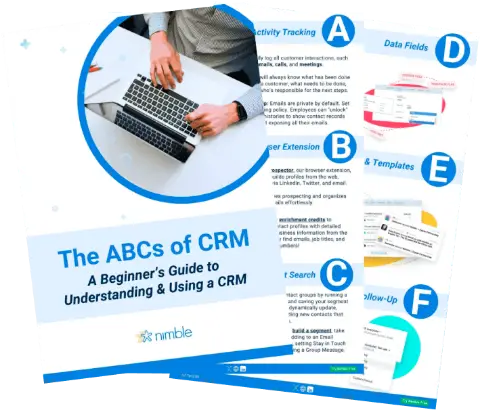
Free Guide
The ABCs of CRM
A Beginner's Guide to Understanding &
Using a CRM
Download Free
You’re All Set!
DownloadGet the most out of this guide by starting your free 14-day trial of Nimble today.
This approach also prevents over-communication. Nothing damages trust faster than sending repeated automated messages to someone who has already responded or clearly lost interest. Automation with behavioral logic protects the relationship while maximizing efficiency.
Tip 5: Keep Automation Human Through Personalization and Ownership
One of the most common criticisms of automated follow-up is that it feels cold or robotic. This is not a flaw of automation itself, but of how it is implemented.
Effective CRM follow-up automation maintains a human tone and clear ownership. Messages should sound like they come from a real person, not a system. This means using natural language, avoiding overly promotional phrasing, and writing as if you expect a reply.
Personalization plays a major role here. Referencing the contact’s name, form topic, or stated interest creates familiarity. Even small details can significantly improve engagement and response rates.
Ownership is equally important. Automated messages should clearly indicate who is responsible for the follow-up. When contacts know there is a real person behind the communication, they are more likely to respond and trust the process.
Automation should support human relationships, not replace them. Its role is to handle timing, consistency, and logistics so that your team can focus on meaningful conversations when they happen.
Tip 6: Implement CRM Follow-Up Automation for Lead Ownership
One of the fastest ways to kill a web form lead is internal confusion. When no one clearly owns the follow-up, contacts sit untouched or receive duplicate outreach from multiple people. CRM automation should eliminate this problem entirely.
Every web form submission should trigger automatic lead ownership assignment based on predefined rules. Ownership can depend on geography, product interest, deal size, or team workload. The important part is that responsibility is immediate and unambiguous.
When ownership is automated, the lead instantly becomes someone’s priority instead of “everyone’s responsibility,” which in practice means no one acts.
Example
A B2B company uses three web forms: general contact, demo request, and enterprise pricing inquiry.
- General contact forms are assigned to an inbound sales coordinator.
- Demo requests are routed directly to account executives.
- Enterprise pricing inquiries are assigned to a senior sales manager.
The CRM sends a notification to the assigned owner the moment the form is submitted. If no action is taken within a set time window, the system escalates the lead to a backup owner. As a result, no form submission ever goes unanswered, and accountability is built into the process.
Tip 7: Use Delay Logic to Match Real Human Availability
One common automation mistake is sending messages at technically correct but socially awkward times. A form submission at 3:00 a.m. may trigger an instant email, but that does not always align with how people expect businesses to operate.
Smart CRM automation includes delay logic that respects time zones, business hours, and realistic response expectations. This does not mean slowing down unnecessarily, but rather aligning automation with human rhythms.
Delay logic can also improve perceived personalization. A response that arrives at 9:05 a.m. often feels more intentional than one sent at 2:47 a.m., even if both are automated.
Example
A global service company receives web form submissions from multiple regions.
- If a form is submitted during local business hours, the confirmation message is sent immediately.
- If it is submitted outside business hours, the CRM schedules the message for the next morning.
- A second follow-up is delayed until a human sales representative is likely available to respond.
This approach maintains speed while preserving professionalism. Contacts feel acknowledged without feeling like they are interacting with an always-on machine.
Tip 8: Automate Internal Follow-Up, Not Just External Messages
CRM follow-up automation is often focused entirely on customer-facing communication. While that is essential, internal follow-up is just as important.
Automation should prompt your team to act, not just your prospects. Internal reminders, task creation, and alerts ensure that automated messages lead to real human engagement at the right moment.
Without internal automation, external follow-up can become disconnected from actual sales activity. Messages go out, but no one is prepared to respond when the contact replies.
Example
A CRM workflow creates the following internal actions when a web form is submitted:
- A task is automatically created for the assigned sales rep with a recommended follow-up deadline.
- A reminder is triggered if the task is not completed within the expected timeframe.
- If the lead replies to an automated message, the CRM sends an instant alert to the owner.
This internal automation ensures that no response is missed and that sales representatives are always aware of which leads require immediate attention.
Tip 9: Use Progressive Disclosure Instead of Information Overload
When someone submits a web form, they rarely want to receive all possible information at once. Overloading contacts with long messages or multiple attachments can reduce engagement and increase drop-off.
Effective CRM automation uses progressive disclosure, delivering information in small, relevant steps rather than all at once. Each message has a clear purpose and introduces only what is necessary at that stage.
This approach mirrors natural conversation. You do not explain everything in the first sentence; you build context over time.
Example
A software company automates follow-up for users requesting more information.
- The first message confirms the request and briefly explains what the product solves.
- The second message highlights a common use case relevant to the form selection.
- The third message invites the contact to ask questions or schedule a conversation.
By spacing information logically, the company increases engagement while avoiding cognitive overload. Contacts stay curious instead of feeling overwhelmed.
Tip 10: Create Exit Paths for Unresponsive Leads
Not every web form contact will convert, and that is normal. What matters is how your CRM handles unresponsive leads over time.
Automation should include clear exit paths that prevent endless follow-up loops. Continuing to message unresponsive contacts indefinitely damages brand perception and wastes system resources.
Exit paths allow leads to gracefully move into long-term nurturing, archival status, or periodic re-engagement campaigns without constant pressure.
Example
A CRM sequence follows this logic:
- Three follow-up messages are sent over two weeks.
- If the contact does not open or reply, the sequence ends.
- The lead is moved into a low-frequency educational segment.
- After three months, the CRM sends a single re-engagement message.
This approach respects the contact’s silence while keeping the door open for future interest. It also ensures that sales teams focus on leads that are actively engaging.
Closing Perspective: Automation Is a System, Not a Shortcut
CRM follow-up automation for web form contacts works best when viewed as a system rather than a shortcut. Each automated action should support a larger goal: faster response, better relevance, clearer ownership, and more meaningful conversations.
The most effective strategies combine immediate acknowledgment, intelligent segmentation, multi-step communication, behavioral adaptation, human tone, internal accountability, and respectful exit paths.
When these elements work together, automation does not feel automated. It feels organized, thoughtful, and reliable. And in a competitive digital environment, reliability is often the deciding factor between a lost lead and a long-term customer.
Mastering CRM Follow-Up Automation: Common Questions
It eliminates human delay by ensuring every web form lead is contacted while their intent is at its peak. By automating the first touch, you guarantee a 100% response rate and can move leads into personalized nurture sequences instantly.
Yes. A unified engine allows you to trigger sales-focused 1:1 sequences for high-intent leads and graphical marketing newsletters for long-term nurturing, all within the same automated workflow.
No. Unlike fragmented systems, a unified CRM automatically segments web form contacts and places them into the correct automation path based on their behavior or form data, removing the need for manual CSV exports.
Use personalization tags and behavioral triggers. By referencing the contact’s name or specific form interest and only sending messages when they are active, the automation feels like a natural extension of your team.