

Last updated:
Quick answer: If a prospect hasn’t replied, wait 3–5 business days, then send a short, low-pressure follow-up that references your original message and adds one new piece of value (a tip, a quick win, or a relevant example) rather than just asking “did you see this?” Two to three follow-ups spaced out over 2–3 weeks is typically enough — after that, a final “should I close your file?” email is the standard close. Nimble CRM automates this entire sequence so nothing falls through manually.
When sending emails to prospects or clients, you may often encounter silence. Not getting a response doesn’t necessarily mean a lack of interest—it could simply be a matter of timing, inbox overload, or a need for further engagement. A well-crafted follow-up email can significantly increase response rates, build relationships, and ultimately drive conversions. For the complete guide to sales for small business — including prospecting, sequences, pipeline management, and closing — see our full guide.
6 Follow-Up Email Examples You Can Use Today
Example 1: The Gentle Reminder Email
USE WHEN It’s early — first or second follow-up, no urgency yet.
Subject: Just Checking In – Still Interested?
Hi [Name],
I wanted to follow up on my previous message about [topic]. If you’re still interested, I’d love to find a time to talk — or happy to answer any questions first.
WHY IT WORKS Low-pressure, quick, gives an easy path to reply.
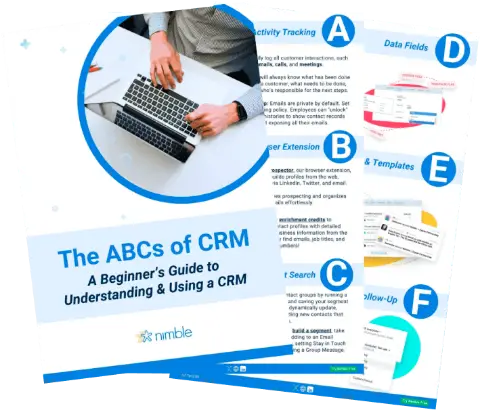
Free Guide
The ABCs of CRM
A Beginner's Guide to Understanding &
Using a CRM
Download Free
You’re All Set!
DownloadGet the most out of this guide by starting your free 14-day trial of Nimble today.
Example 2: The Value-Driven Follow-Up
USE WHEN You have a genuinely useful tip or insight to share, not just a reminder.
Subject: A Quick Tip That Might Help You
Hi [Name],
Following up — and wanted to share something that’s worked well for others in [their situation]: [specific tip]. Want me to send more on this, or grab 10 minutes this week?
WHY IT WORKS Leads with something useful instead of a sales ask.
Example 3: The Urgency-Based Follow-Up
USE WHEN There’s a real deadline — don’t manufacture one.
Subject: Last Chance: [Offer] Ends [Date]
Hi [Name],
Didn’t want you to miss [offer] before it closes on [date]. Happy to answer anything quickly if that helps you decide.
WHY IT WORKS A genuine deadline creates a legitimate reason to reply now.
Example 4: The Social Proof Follow-Up
USE WHEN You have a relevant, specific customer result to point to.
Subject: How [Client] Got [Result]
Hi [Name],
Thought you’d find this useful — [Client] used [solution] and saw [specific measurable result]. Worth a quick chat on whether something similar could work for you?
WHY IT WORKS A concrete outcome is more persuasive than a general pitch.
Example 5: The Friendly Nudge
USE WHEN It’s genuinely casual — internal contacts, warm relationships.
Subject: Just Making Sure You Saw This
Hi [Name],
Following up in case my last note got buried. Still relevant to you? Happy to send more info or just circle back later — your call.
WHY IT WORKS Removes pressure entirely; keeps the door open without pushing.
Example 6: The Straight-to-the-Point Close
USE WHEN It’s your final follow-up in a sequence.
Subject: Would You Like to Move Forward?
Hi [Name],
Checking in one last time on [topic]. If now’s not the right time, no worries — just let me know and I’ll circle back later. If you are interested, happy to set up a call whenever works.
WHY IT WORKS Gives a clean, guilt-free “no” option, which often produces an honest answer either way.
How to Automate Your Follow-Up Sequence in Nimble CRM
Manually tracking who needs a follow-up, and when, doesn’t scale past a handful of leads. Here’s the full setup in Nimble:
- Build the sequence
Go to Email Sequences in Nimble CRM → New Sequence → name it (e.g., “Follow-Up After No Response”). Add your initial email plus 2–3 follow-ups, spaced a few days apart (day 0, day 3, day 7 is a solid default). - Personalize with merge tags
Pull in name, company, and prior interaction details automatically so each email still reads as individual, not templated. - Set exit conditions
The most important step: tell Nimble to pull a contact out of the sequence the moment they reply, so no one gets a follow-up after they’ve already responded. - Add behavior-based logic
Nimble can branch the sequence based on what the recipient actually does — for example, a lighter nudge if they opened but didn’t reply, or a fresh subject line if they never opened at all. - Send from your own address
Emails send from your real inbox rather than a bulk sender, which keeps them out of spam and preserves reply-ability. - Track and adjust
Nimble’s reporting shows opens, clicks, and reply rates per sequence, so you can see which version of a follow-up is actually working and adjust from there.
This same setup works beyond sales — support teams use it for ticket follow-ups, HR for application status updates, marketing for nurture sequences.