

Last updated:
Customer Relationship Management (CRM) systems have become indispensable tools for businesses aiming to streamline operations, enhance customer satisfaction, and drive growth. When leveraged effectively, a CRM can transform business development efforts by providing actionable insights, improving team collaboration, and fostering stronger relationships with prospects and clients. However, simply adopting a CRM isn’t enough—success lies in how it’s implemented and utilized. In this article, we’ll explore three best practices for using a CRM to supercharge business development: centralizing data for actionable insights, automating workflows to boost efficiency, and personalizing customer interactions to build trust and loyalty.
1. Centralizing Data for Actionable Insights
One of the most powerful features of a CRM is its ability to serve as a single source of truth for all customer-related information. For business development teams, this centralization is a game-changer. Rather than sifting through scattered spreadsheets, emails, or sticky notes, a well-implemented CRM consolidates data such as contact details, communication history, purchase records, and prospect interactions into one accessible platform. This unified view empowers teams to make informed decisions, identify opportunities, and act swiftly.
The first step in this best practice is ensuring that all relevant data is consistently entered into the CRM. This includes not just basic information like names and phone numbers, but also notes from meetings, email exchanges, and even social media interactions if applicable. For example, a business development representative might log a prospect’s recent complaint about a competitor’s product, which could later inform a tailored pitch. Without centralized data, such insights risk being lost or overlooked.
Once the data is centralized, the next key is leveraging the CRM’s reporting and analytics tools. Modern CRMs offer dashboards and customizable reports that can highlight trends, such as which industries are showing the most interest in your product or which sales stages tend to stall. For instance, if the data reveals that prospects from the healthcare sector frequently drop off after the demo stage, the business development team can investigate and adjust their approach—perhaps by refining the demo to address sector-specific pain points. These insights enable proactive rather than reactive strategies, a critical advantage in competitive markets.
Moreover, centralizing data fosters collaboration across departments. Business development doesn’t operate in a vacuum—it often overlaps with marketing, sales, and customer support. A CRM that’s accessible to all relevant teams ensures everyone is on the same page. For example, if marketing runs a campaign targeting a specific demographic, the business development team can use the CRM to track how those leads progress through the pipeline, adjusting outreach efforts accordingly. This alignment maximizes efficiency and prevents duplicated efforts or mixed messages.
To make this practice effective, businesses must enforce data hygiene. Incomplete or outdated records can undermine the CRM’s value. Regular audits, standardized data entry protocols, and training for team members are essential to maintain accuracy. When done right, centralizing data in a CRM transforms it into a strategic asset, giving business development teams the clarity and confidence to pursue growth opportunities.
2. Automating Workflows to Boost Efficiency
Time is a precious commodity in business development, where every minute spent on administrative tasks is a minute not spent building relationships or closing deals. This is where automation—a cornerstone of modern CRM systems—comes into play. By automating repetitive tasks, businesses can free up their teams to focus on high-value activities like strategizing, networking, and engaging with prospects.
A prime example of automation in action is lead management. In a typical business development process, leads come from various sources—website forms, trade shows, referrals, or inbound inquiries. Manually entering these leads into a system, assigning them to team members, and following up can be time-consuming and error-prone. A CRM can automate this workflow by capturing leads directly from integrated sources (like a website or email platform), scoring them based on predefined criteria (e.g., company size or budget), and assigning them to the appropriate representative. Follow-up emails or reminders can also be scheduled automatically, ensuring no lead slips through the cracks.
Task automation extends beyond lead management. For instance, CRMs can automate the creation of proposals or contracts once a prospect reaches a certain stage in the pipeline. Imagine a scenario where a business development manager moves a deal to the “proposal sent” stage—the CRM could instantly generate a personalized document using stored templates and data, then notify the prospect via email. This not only saves time but also maintains consistency in branding and messaging.
Another powerful application is in nurturing relationships. Business development often involves long sales cycles, especially in B2B contexts, where prospects need multiple touchpoints before committing. A CRM can automate drip email campaigns tailored to different segments—say, one sequence for cold leads and another for warm prospects who’ve attended a webinar. These automated touchpoints keep the business top-of-mind without requiring constant manual intervention.
However, automation isn’t a set-it-and-forget-it solution. The best practice here is to regularly review and refine these workflows. Are the lead-scoring rules still relevant? Are automated emails driving engagement, or do they need tweaking? Analytics from the CRM can answer these questions, allowing businesses to optimize their processes continually. Additionally, striking a balance is key—over-automation can make interactions feel robotic, which risks alienating prospects. The goal is to enhance efficiency while preserving the human touch that business development thrives on.
By automating routine tasks, CRMs enable teams to scale their efforts without scaling their workload. This efficiency translates into more opportunities pursued, faster response times, and ultimately, a stronger pipeline—all critical drivers of business growth.
3. Personalizing Customer Interactions to Build Trust and Loyalty
In today’s competitive landscape, generic pitches and one-size-fits-all approaches rarely cut it. Prospects and clients expect tailored experiences that demonstrate an understanding of their unique needs and challenges. A CRM, when used strategically, empowers business development teams to deliver this level of personalization at scale, fostering trust and long-term loyalty.
The foundation of personalization lies in the data stored within the CRM. Every interaction—whether a phone call, email, or in-person meeting—provides clues about a prospect’s preferences, pain points, and goals. For example, if a CRM notes that a potential client in the manufacturing sector frequently asks about scalability, the business development team can craft a pitch emphasizing how their solution adapts to growing production demands. This targeted approach signals that the business isn’t just selling a product—it’s solving a specific problem.
Personalization also extends to timing and communication style. CRMs can track when prospects are most responsive—say, Tuesday mornings versus Friday afternoons—and schedule outreach accordingly. They can also store preferences, like whether a client prefers concise emails over detailed reports. Armed with this information, business development professionals can tailor their interactions to suit each individual, increasing the likelihood of a positive response.
Beyond initial outreach, personalization strengthens ongoing relationships. For instance, a CRM can alert a team member to a client’s one-year anniversary with the company, prompting a congratulatory message or a special offer. These small gestures show appreciation and reinforce the client’s value, which is especially important in business development, where retaining existing clients can be as critical as acquiring new ones. In fact, studies consistently show that increasing customer retention by just 5% can boost profits by 25% to 95%, underscoring the ROI of personalized engagement.
To maximize this practice, businesses should integrate their CRM with other tools, such as email platforms or social media channels, to capture a fuller picture of customer behavior. For example, if a prospect engages with a LinkedIn post about sustainability, the CRM could flag this interest, prompting a follow-up that ties the business’s offerings to eco-friendly benefits. This level of detail turns generic conversations into meaningful dialogues.
That said, personalization must be authentic. Overusing data or forcing connections can come across as manipulative rather than thoughtful. The best approach is to use CRM insights as a starting point, then let human judgment guide the interaction. Training team members to interpret and act on CRM data effectively is crucial—technology provides the tools, but people bring the nuance.
When personalization is done well, it builds trust by showing prospects and clients that they’re more than just a number. This trust lays the groundwork for lasting partnerships, repeat business, and referrals—all of which fuel sustainable business development.

4. Aligning Sales and Business Development Goals
Business development and sales teams often share overlapping objectives—both aim to grow revenue and expand the company’s reach—but their approaches and timelines can differ. Sales typically focuses on closing deals in the short term, while business development emphasizes long-term relationships and strategic partnerships. A CRM can bridge this gap by aligning both teams around shared goals, ensuring cohesive efforts that maximize overall impact.
The first step in this practice is defining clear, unified objectives within the CRM. For example, a company might set a goal to increase revenue from new markets by 20% over the next year. The CRM can then track key performance indicators (KPIs) for both teams—such as the number of new leads generated by business development or the conversion rate of those leads by sales. By housing these metrics in a shared system, everyone sees how their contributions fit into the bigger picture.
Collaboration is further enhanced through shared workflows. A CRM can facilitate handoffs between teams, ensuring a smooth transition from prospecting to closing. For instance, when a business development representative identifies a promising partnership with a mid-sized retailer, they can log the details—key contacts, pain points, and potential deal size—in the CRM. The sales team can then pick up where business development left off, armed with all the context needed to seal the deal. Automated alerts or task assignments in the CRM can streamline this process, reducing delays and miscommunication.
Transparency is another benefit of alignment. With a CRM, both teams can monitor progress in real time via dashboards or reports. If business development notices that sales is struggling to convert leads from a specific industry, they might adjust their outreach to refine the lead pool. Conversely, if sales identifies a recurring objection, they can flag it in the CRM for business development to address in future conversations. This feedback loop fosters a culture of mutual support rather than silos.
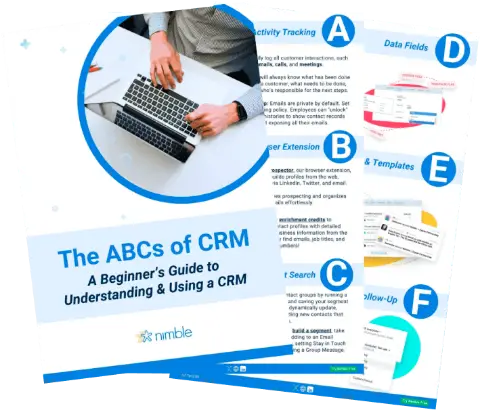
Free Guide
The ABCs of CRM
A Beginner's Guide to Understanding &
Using a CRM
Download Free
You’re All Set!
DownloadGet the most out of this guide by starting your free 14-day trial of Nimble today.
To make this practice effective, leadership must champion CRM adoption and enforce accountability. Regular check-ins—using CRM data to review progress—keep teams aligned and motivated. Training is also critical, as not all team members may instinctively see the CRM as a collaborative tool rather than just a tracking system. When sales and business development operate in sync, the result is a more efficient pipeline, stronger partnerships, and accelerated growth—a win for the entire organization.
5. Using Predictive Analytics to Anticipate Opportunities
In business development, timing is everything. Reaching out to a prospect too early or too late can mean a missed opportunity. Fortunately, modern CRMs come equipped with predictive analytics, a feature that uses historical data, machine learning, and pattern recognition to forecast trends and identify high-potential opportunities. Leveraging this capability allows business development teams to shift from reactive to proactive strategies, staying ahead of the curve.
Predictive analytics starts with the wealth of data already in the CRM—past deals, customer behaviors, and market interactions. The system analyzes this information to predict outcomes, such as which leads are most likely to convert or which existing clients might be ready for an upsell. For example, if the CRM notices that companies with 50-100 employees in the tech sector tend to sign contracts after three touchpoints, it can flag similar prospects in the pipeline, prompting the team to prioritize them.
This foresight extends to market trends as well. A CRM might detect seasonal patterns—like a spike in demand for logistics solutions every November—and alert the business development team to prepare targeted campaigns in advance. Similarly, it can identify at-risk accounts by spotting red flags, such as a drop in engagement from a long-term client, allowing the team to intervene before the relationship sours. These predictions transform guesswork into data-driven decisions.
Implementing this practice requires a robust data foundation. Predictive analytics is only as good as the information it’s based on, so businesses must ensure their CRM contains comprehensive, up-to-date records. This might mean integrating external data sources—like industry reports or economic indicators—to enrich the analysis. Once the system is humming, the team should act on its recommendations, testing and refining their approach based on results. For instance, if the CRM predicts a 70% likelihood of closing a deal with a specific prospect, the team might allocate extra resources to that opportunity, then track the outcome to validate the model.
However, predictive analytics isn’t infallible. Human oversight remains essential to interpret the data and adjust for nuances that algorithms might miss—like a prospect’s sudden budget cut due to unforeseen circumstances. The best practice is to treat predictions as a guide, not a gospel, blending them with the team’s expertise. When wielded effectively, predictive analytics gives business development a crystal ball, enabling them to anticipate needs, seize opportunities, and outpace competitors.
6. Integrating CRM with Other Systems for a Holistic Approach
A CRM is most powerful when it doesn’t operate in isolation. Business development relies on a web of activities—marketing campaigns, customer support tickets, financial tracking—that span multiple tools and departments. Integrating the CRM with these other systems creates a holistic ecosystem, providing a 360-degree view of the customer journey and streamlining operations for maximum efficiency.
Integration with marketing tools is a prime example. Many businesses use platforms like Mailchimp or HubSpot to run email campaigns or manage social media outreach. Linking these to the CRM ensures that every interaction—say, a prospect clicking a campaign link or attending a webinar—flows directly into the system. This gives business development instant visibility into which marketing efforts are generating viable leads, allowing them to follow up with precision. For instance, if a prospect downloads a whitepaper on cybersecurity, the CRM can trigger a task for the team to reach out with a relevant case study.
Customer support integration is equally valuable. When a client submits a ticket through a system like Zendesk, syncing it with the CRM lets business development see the full context of the relationship. If a key account reports a recurring issue, the team can proactively address it in their next meeting, turning a potential pain point into a trust-building moment. This visibility also helps identify upsell opportunities—happy clients with resolved issues might be ripe for additional services.
Financial tools, such as QuickBooks or SAP, can also tie into the CRM, linking revenue data to customer profiles. This allows business development to prioritize high-value accounts or spot declining spend trends that warrant attention. For example, if a client’s annual spend drops by 15%, the team can dig into the CRM to investigate—perhaps they’ve shifted to a competitor—and craft a strategy to win them back.
The key to successful integration is selecting the right tools and ensuring seamless data flow. APIs, middleware, or native integrations offered by CRM providers (like Salesforce or HubSpot) can make this happen. However, businesses must also map out how data should move—deciding which fields sync and how often—to avoid clutter or duplication. Regular testing and maintenance are crucial to keep the integrations running smoothly, as updates to one system can disrupt others.
The payoff is a unified operation where business development has all the information they need at their fingertips. This holistic approach eliminates blind spots, enhances decision-making, and ensures every team member—from marketing to finance—contributes to growth. It’s the difference between a fragmented effort and a well-oiled machine.
Using CRM for Business Development with Nimble: Featuring 10 Practical Examples

Customer Relationship Management (CRM) systems are vital for businesses looking to optimize their development strategies, and Nimble CRM stands out as a relationship-focused solution designed for solopreneurs and teams alike. Built by Jon Ferrara, a co-creator of the pioneering CRM GoldMine, Nimble has been empowering users for over a decade with features that streamline relationship management, prospect outreach, and sales processes. To unlock its full potential for business development, three best practices stand out: leveraging centralized relationship management, harnessing automation for efficiency, and driving growth through integrated tools. Below, we explore these practices, enriched with 10 real-world examples based on Nimble’s key features, including Relationship Management, Prospect Marketing & Outreach, Sales, Pipelines, & Reporting, Inbox, Mobile, Social CRM, Workflows & Automations, Web Forms, Microsoft 365, Google Workspace, Mobile, and Email Marketing.
1. Leveraging Centralized Relationship Management for Strategic Growth
Centralizing customer data is a cornerstone of effective business development, and Nimble excels at this with its Relationship Management feature. By consolidating contacts, calendars, emails, and social interactions into a single, customizable dashboard, Nimble provides a comprehensive view of relationships, enabling teams to strategize and act with precision.
Example 1: Relationship Management
A small consulting firm uses Nimble to manage its client relationships. After a team member meets a potential client at a conference, they log the contact’s details, including a note about their interest in leadership training, directly into Nimble from LinkedIn using the platform’s seamless integration. Weeks later, when preparing a proposal, the team reviews the full communication history—emails, calls, and social interactions—all centralized in Nimble, ensuring a tailored pitch that wins the contract.
Example 2: Inbox, Mobile, Social CRM
A real estate agent accesses Nimble from their Gmail inbox while responding to a prospect’s inquiry. Using the Inbox, Mobile, Social CRM feature, they instantly view the prospect’s past emails and Twitter mentions about property preferences, allowing them to craft a personalized response without leaving their inbox. This quick access strengthens the relationship and accelerates the sales process.
Nimble’s integration with Microsoft 365 and Google Workspace further enhances this practice by syncing team calendars and emails, ensuring everyone has real-time visibility. For instance, when a business development manager schedules a follow-up call, the team can see it in their shared Nimble dashboard, avoiding overlap and reinforcing collaboration. Regularly updating records—such as tagging key decision-makers or logging meeting outcomes—keeps the data actionable, turning relationships into revenue opportunities.
2. Harnessing Automation for Efficiency and Scale
Automation is a game-changer for business development, freeing teams from repetitive tasks to focus on high-impact activities. Nimble’s Workflows & Automations and Email Sequences features allow businesses to streamline processes and scale outreach efforts effectively.
Example 3: Workflows & Automations
A marketing agency sets up a Nimble workflow to automate lead qualification. When a prospect fills out a Web Forms inquiry on the agency’s website—integrated with Nimble—the system automatically assigns them to a “New Leads” stage, triggers an introductory email via Email Sequences, and alerts a team member to follow up within 48 hours. This automation cuts manual entry time by hours, enabling the team to pursue more leads.
Example 4: Email Sequences
A SaaS startup uses Nimble’s Email Sequences to nurture cold leads. After uploading a list of prospects from a trade show, they create a sequence of three emails: an introduction, a case study, and a demo offer. Nimble sends these from the team’s own email addresses, tailoring content based on recipient actions (e.g., opening the first email triggers the second). The result? A 30% increase in demo bookings without additional effort.
Example 5: Prospect Marketing & Outreach
A freelance graphic designer leverages Prospect Marketing & Outreach to scale their outreach. Using Nimble Prospector, they identify 50 potential clients on LinkedIn, enrich their profiles with contact details, and send a group email blast offering a portfolio review. Nimble tracks opens and clicks, revealing five hot leads who receive personalized follow-ups, landing two new projects.
Automation requires fine-tuning—reviewing analytics to adjust email timing or workflow triggers ensures optimal performance. By blending these tools with human oversight, businesses maintain efficiency while preserving the personal touch critical for development.
3. Driving Growth Through Integrated Tools and Insights
Nimble’s robust integrations and reporting capabilities empower businesses to turn data into growth. Features like Sales, Pipelines, & Reporting, Mobile, and Email Marketing provide the tools to track progress, stay agile, and engage prospects effectively.
Example 6: Sales, Pipelines, & Reporting
A B2B software company uses Nimble’s Sales, Pipelines, & Reporting to manage its pipeline. They create multiple pipelines—one for new clients, another for upsells—and customize stages (e.g., “Demo Scheduled,” “Proposal Sent”). When a deal moves to “Closed Won,” Nimble’s reporting dashboard shows a 25% conversion rate increase year-over-year, guiding the team to double down on demo-focused outreach.
Example 7: Mobile
A sales rep on the road uses Nimble’s Mobile app to prepare for a client meeting. While at a coffee shop, they pull up a prospect’s dossier—complete with recent emails, social posts, and deal status—via their phone. Armed with this intel, they address the prospect’s pain points during the meeting, securing a $10,000 contract on the spot.
Example 8: Email Marketing
A boutique retailer launches a holiday campaign using Nimble’s new Email Marketing feature. They design a newsletter with product promotions and send it to a segmented list of past customers, captured via Web Forms on their site. Nimble tracks engagement, showing a 40% open rate, prompting a follow-up sequence that boosts sales by 15%.
Example 9: Microsoft 365
A financial advisory firm integrates Nimble with Microsoft 365. When a client emails about investment options, the advisor logs the interaction in Nimble from Outlook, schedules a Teams call, and assigns a task—all synced across the team’s Microsoft ecosystem. This integration ensures no opportunity slips through, strengthening client trust and retention.
Example 10: Google Workspace
A tech startup syncs Nimble with Google Workspace to manage a partnership campaign. After a prospect submits a Web Forms request via their Google Site, Nimble adds them to a pipeline and syncs the lead’s Gmail interactions. The team collaborates via Google Calendar to schedule a pitch, using Nimble’s insights to tailor it, resulting in a signed partnership deal.
These integrated tools provide a holistic approach, connecting marketing, sales, and support efforts. Regular analysis—such as reviewing pipeline reports or mobile usage patterns—ensures strategies evolve with the business, driving sustainable growth.
Conclusion
A CRM is far more than a digital Rolodex—it’s a strategic engine for business development when used with intention and skill. Centralizing data provides the insights needed to identify and seize opportunities. Automating workflows frees up time for meaningful work, amplifying team productivity. Personalizing interactions deepens relationships, turning prospects into loyal advocates. Together, these best practices unlock the full potential of a CRM, driving efficiency, growth, and customer satisfaction.
To succeed, businesses must commit to ongoing optimization—cleaning data, refining automations, and training teams to leverage the system effectively. The investment pays off in a stronger pipeline, higher conversion rates, and a competitive edge. In an era where relationships and agility define success, mastering these CRM practices isn’t just a good idea—it’s a business imperative.