

Website traffic is great. Form submissions feel like progress. But if your sales team is drowning in low-intent leads, unqualified inquiries, or people who were “just looking,” then your website isn’t generating real opportunities—it’s creating noise. Learning how to qualify website leads effectively is the difference between busy sales teams and profitable sales teams. The goal isn’t just to get more volume—it’s to qualify website leads early so your team focuses only on high-intent opportunities.
Tip 1: How to Qualify Website Leads Before They Submit a Form
Most websites treat all leads equally. That’s the first mistake.
The smartest qualification happens before a lead ever reaches your CRM.
Use Intent-Based Form Fields (Not More Fields)
Adding 20 fields to a form doesn’t qualify leads—it scares them away. Instead, use strategic questions that reveal intent:
- “What are you looking for today?”
- “What best describes your role?”
- “When are you planning to start?”
- “Estimated budget range”
- “Is this for personal or business use?”
One or two well-chosen questions can tell you more than a phone call.
Example:
A moving company website asks:
“When do you plan to move?”
- Just researching
- Within 30 days
- 1–3 months
- Urgent / ASAP
That single question instantly separates casual browsers from high-intent buyers.
Use Conditional Logic to Filter Automatically
Modern forms allow conditional logic:
- Show different fields based on answers
- Redirect low-intent leads to educational content
- Route high-intent leads directly to sales
This prevents your sales team from chasing people who aren’t ready—or aren’t a fit at all.
Tip 2: Track the Source and Behavior of Every Lead
A lead is never just a form submission. Context matters.
To qualify leads properly, you need to know where they came from and what they did before converting.
High-Intent Sources vs Low-Intent Sources
Not all traffic converts equally:
- High intent:
- Google Search (commercial keywords)
- Pricing pages
- Comparison pages
- “Contact sales” CTAs
- Lower intent:
- Display ads
- Social media traffic
- Blog posts
- Free tools or downloads
If someone lands on your site, reads three pricing pages, and then submits a form—that’s a hot lead.
If they read one blog post and bounce into a form—that’s a warm (or cold) one.
Capture UTM Parameters Automatically
Make sure your forms capture:
- Source/medium
- Campaign
- Landing page URL
- Referring keyword (when possible)
When these details are stored in your CRM, sales teams can prioritize leads based on intent, not guesswork.
CRMs like Nimble CRM automatically enrich leads with source data, social context, and interaction history—making qualification faster and more accurate.
Tip 3: Score and Qualify Website Leads Automatically
Manual qualification doesn’t scale. Lead scoring does.
What Is Lead Scoring?
Lead scoring assigns points based on:
- Who the lead is (demographics)
- What they do (behavior)
- How they arrived (source)
The higher the score, the higher the priority.
Example of a Simple Website Lead Scoring Model
Demographic criteria
- Business email: +10
- Job title includes “Manager” or “Founder”: +15
- Company size over 10 employees: +10
Behavioral criteria
- Visited pricing page: +20
- Downloaded a guide: +10
- Returned to site within 7 days: +15
Source-based criteria
- Google Search (high-intent keyword): +20
- Referral partner: +15
- Social media ad: +5
Now your sales team can instantly see:
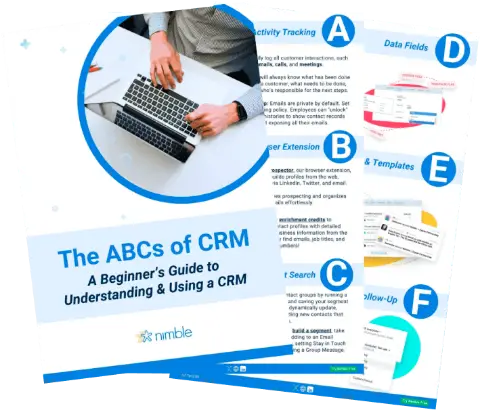
Free Guide
The ABCs of CRM
A Beginner's Guide to Understanding &
Using a CRM
Download Free
You’re All Set!
DownloadGet the most out of this guide by starting your free 14-day trial of Nimble today.
- Leads above 60 = sales-ready
- Leads 30–60 = nurture
- Leads under 30 = educational flow
This removes emotion and bias from qualification and replaces it with data.
Tip 4: Use Micro-Conversions to Qualify Website Leads Before the Sale
Not everyone who lands on your site is ready to talk to sales—and that’s okay.
The trick is to qualify gradually, using micro-conversions.
What Are Micro-Conversions?
Micro-conversions are small actions that indicate growing interest:
- Email newsletter signup
- Downloading a checklist
- Viewing a pricing page
- Watching a demo video
- Requesting a quote instead of a general contact form
Each micro-conversion adds context and confidence.
Why Micro-Conversions Improve Lead Quality
Instead of pushing everyone into “Contact Us,” you:
- Educate early-stage visitors
- Build trust over time
- Identify serious prospects naturally
By the time someone fills out a sales form, they’ve already:
- Consumed your content
- Understood your value
- Self-qualified as interested
This dramatically increases close rates and reduces wasted sales calls.
Tip 5: Segment and Route Leads Automatically
The fastest way to lose a good lead is to treat them like everyone else.
Qualification doesn’t end at the form—it continues in how leads are handled next.
Segment Leads Immediately After Submission
Based on form answers, source, and score, route leads into:
- Sales-ready queue
- Nurture campaigns
- Partner follow-ups
- Support or onboarding flows
For example:
- “Budget under $500” → educational sequence
- “Budget $5,000+” → immediate sales call
- “Just researching” → content drip campaign
Speed = Qualification
High-intent leads decay fast. Studies consistently show:
- Contact within 5 minutes = highest conversion
- Contact after 30 minutes = conversion drops sharply
- Contact after 24 hours = almost dead
Automation ensures:
- Hot leads get immediate attention
- Cold leads aren’t rushed
- Sales teams focus only on qualified opportunities
Tip 6: Build Sales Pipelines Around Your Qualified Website Leads
One of the biggest conversion killers is asking leads for information you can get automatically.
Nimble solves this by enriching leads the moment they enter the CRM.
What Nimble Auto-Enrichment Gives You
As soon as a website lead syncs into Nimble, it can automatically pull:
- Company name and industry
- Company size
- Website URL
- Social profiles
- Job title and role
- Location
This allows you to qualify leads silently, without friction.
Example: B2B Service Website
A lead submits a simple form:
- Name
- Message
Inside Nimble, enrichment reveals:
- Job title: Head of Marketing
- Company size: 50–200 employees
- Industry: E-commerce
Now sales instantly know:
- Decision-maker ✔
- Budget likely ✔
- Relevant industry ✔
That lead moves straight to sales priority, while others don’t.
Result:
Higher qualification accuracy with fewer form fields.
Tip 7: Use Custom Fields to Define “Qualified” for Your Business
Generic qualification rules don’t work across industries.
Nimble allows you to build custom qualification logic tailored to your exact sales model.
Create Custom Qualification Fields
Examples of Nimble custom fields:
- Lead Intent (Low / Medium / High)
- Budget Range
- Timeline
- Lead Type (Inbound / Paid / Partner)
- Product Interest
- Sales Readiness Score
These fields turn subjective sales opinions into structured data.
Example: Website Quote Requests
Form answers sync into Nimble fields:
- Timeline → “Within 30 days.”
- Budget → “$5,000+”
- Service → “Full package.”
Nimble rule:
If Budget ≥ $5,000 AND Timeline ≤ 30 days → mark as Sales Qualified Lead (SQL)
No manual review needed.
Result:
Sales talks only to leads that match your real buyer profile.
Tip 8: Qualify Website Leads by Engagement History (Not Just Form Data)
Form answers show intent once.
Engagement shows intent over time.
Nimble automatically tracks every interaction a lead has with your brand.
What Engagement Data Nimble Tracks
- Email opens and replies
- Website interactions (via integrations)
- Meeting history
- Notes and follow-ups
- Social interactions
This gives you behavior-based qualification, not assumptions.
Example: Two Identical Form Submissions
Both leads request a demo.
Lead A:
- Opens follow-up email
- Replies within 10 minutes
- Clicks pricing link
Lead B:
- Never opens email
- No reply
- No follow-up engagement
Inside Nimble:
- Lead A = High Priority
- Lead B = Nurture or Low Priority
Same form. Very different qualifications.
Result:
Sales focuses on people who actually want to talk.
Tip 9: Build Sales Pipelines Based on Qualification Stages
Many teams dump all website leads into one pipeline.
That’s a qualification disaster.
Nimble lets you create pipeline stages specifically for lead qualification.
Example Qualification Pipeline in Nimble
- New Website Lead
- Enriched & Scored
- Contacted
- Sales Qualified
- Opportunity
- Disqualified / Nurture
Each stage forces clarity:
- Why is this lead here?
- What’s missing to move forward?
- Is this a real opportunity?
Real-World Use Case: Agency Website
- New leads enter at New Website Lead
- Auto-enrichment + scoring runs
- Sales reviews only lead to those that reach Sales Qualified
- Others move to Nurture
No more cluttered pipelines.
No more chasing bad leads.
Result:
Predictable qualification and cleaner forecasts.
Tip 10: Automate Follow-Ups to Reveal Lead Quality
Not every lead qualifies immediately—but how they respond tells you everything.
Nimble’s Workflows & Automations help you qualify leads passively.
Example: Automated Qualification Sequence
After form submission:
- Day 0: Confirmation email
- Day 1: “Quick question about your needs.”
- Day 3: Case study relevant to their industry
- Day 7: Soft CTA to book a call
Nimble tracks:
- Who opens
- Who clicks
- Who replies
- Who books a meeting
Leads that engage move up.
Leads that ignore move down.
Why This Works
You’re letting behavior qualify leads for you—without pressure.
Sales only steps in when:
- The lead shows buying signals
- Timing is right
- Interest is proven
Result:
Higher reply rates and fewer awkward sales calls.
Bonus Tip: Use Tags to Instantly Segment Qualified Leads
Tags are one of Nimble’s most underrated qualification tools.
Smart Tag Examples
- “High-Intent Website Lead”
- “Pricing Page Visitor”
- “Decision Maker”
- “Cold Lead”
- “Warm Lead”
- “Hot Lead”
Tags can be:
- Added automatically
- Triggered by behavior
- Used in filters and workflows
Sales can instantly pull:
All High-Intent Website Leads from the last 7 days
That’s a qualification in one click.
Final Takeaway: Nimble Turns Lead Qualification Into a System
With Nimble CRM, lead qualification is no longer:
- Guesswork
- Manual sorting
- Sales frustration
Instead, it becomes:
- Data-driven
- Automated
- Consistent
- Scalable
When your website, forms, and CRM work together, you don’t just collect leads—you identify buyers.
Qualify Website Leads: Frequently Asked Questions
Without an early filter, sales reps waste up to 50% of their time on prospects that aren’t a fit. When you qualify website leads at the form level, you ensure your team only spends energy on high-value conversations that have a real chance of closing.
Yes. By using a CRM with auto-enrichment, you can qualify website leads using just an email address. The CRM pulls company size, job title, and industry data in the background, keeping your forms short and conversion rates high.
Don’t just ignore them. Route unqualified or early-stage website leads into automated nurture sequences. This keeps your brand top-of-mind until they are ready to buy, without distracting your sales team from current high-priority opportunities.
Lead scoring allows you to qualify website leads by assigning numerical values to specific actions, such as visiting a pricing page or having a specific job title. This turns subjective opinions into objective data, letting sales know exactly who to call first.