

Last updated:
Sales prospecting is no longer the sole responsibility of sales departments. In modern companies, especially B2B, SaaS, agencies, and service-based businesses, marketing teams play a direct role in prospecting, lead qualification, and early-stage relationship building. From outbound campaigns to account-based marketing and lead nurturing, marketing professionals increasingly influence who enters the sales pipeline and how prepared those prospects are when sales takes over.
However, many marketing teams struggle with prospecting because they rely too heavily on tools and automation while underinvesting in prospecting skills. Exercises that simulate real-life prospecting scenarios help teams think like buyers, refine messaging, and better align with sales.
Below are five proven sales prospecting exercises designed specifically for marketing teams. Each exercise improves a different part of the prospecting process—from research and targeting to outreach and follow-up—and can be enhanced with tools like Nimble CRM to ensure structure, accountability, and measurable improvement.
1. Ideal Customer Profile (ICP) Reverse Engineering Exercise
What this exercise teaches
This exercise trains marketing teams to deeply understand who they should prospect and why, instead of chasing volume. Many prospecting failures come from targeting the wrong audience or relying on vague personas.
How the exercise works
Start with existing successful customers, not hypothetical personas.
- Each team member selects 3–5 real customers that:
- Converted quickly
- Have high lifetime value
- Required minimal sales friction
- The team then reverse-engineers:
- Industry and company size
- Job titles involved in the buying decision
- Pain points before purchase
- Trigger events (growth, hiring, funding, compliance issues, etc.)
- Compare findings across the team and identify patterns.
Why it works for marketing teams
Marketers often focus on traffic and conversions without fully understanding downstream sales quality. This exercise forces alignment between marketing-qualified leads (MQLs) and sales-qualified leads (SQLs).
How Nimble CRM improves this exercise
Nimble CRM allows marketing teams to:
- Analyze past deals and contacts in one unified view
- Review social, email, and engagement history
- Tag and segment contacts by behavior and attributes
By using Nimble’s contact timelines and segmentation, teams can validate ICP assumptions with real data, not opinions.
2. Cold Outreach Message Deconstruction Workshop
What this exercise teaches
This exercise improves copywriting, positioning, and relevance—three critical skills for outbound prospecting.
How the exercise works
Instead of writing new messages immediately, the team analyzes existing outreach.
- Collect real cold emails, LinkedIn messages, or ads:
- Some that performed well
- Some that failed
- Break each message down into:
- Subject line or opening hook
- Value proposition
- Proof or credibility
- Call to action
- As a group, answer:
- Is the message buyer-centric or company-centric?
- Does it solve a real problem or just describe a product?
- Is the CTA low-friction and logical?
- Rewrite the same message in three different styles:
- Problem-focused
- Outcome-focused
- Social-proof-driven
Why it works for marketing teams
Marketing teams often create campaigns in isolation. This exercise reconnects messaging with real prospect psychology and improves conversion across email, LinkedIn, and paid channels.
How Nimble CRM supports this exercise
Nimble CRM tracks:
- Email opens and replies
- Engagement history per contact
- Relationship strength
Marketing teams can use Nimble data to identify which messages actually triggered engagement, then refine their copy based on evidence instead of assumptions.

3. Prospect Research Speed Drill
What this exercise teaches
Effective prospecting starts with fast, relevant research, not generic outreach. This drill builds speed without sacrificing quality.
How the exercise works
This is a timed exercise designed to simulate real outbound prospecting conditions.
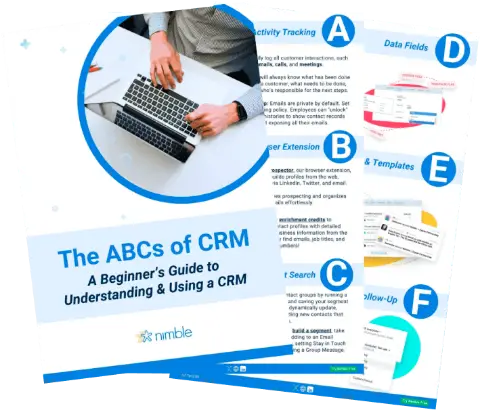
Free Guide
The ABCs of CRM
A Beginner's Guide to Understanding &
Using a CRM
Download Free
You’re All Set!
DownloadGet the most out of this guide by starting your free 14-day trial of Nimble today.
- Give each participant:
- One company name
- One target role (e.g., Head of Marketing, Founder, Operations Manager)
- Set a 10–15 minute timer.
- The task:
- Identify the company’s business model
- Find a potential pain point
- Draft a personalized outreach angle
- At the end, participants present:
- What insight they used
- Why it matters to the prospect
- How they would start the conversation
Why it works for marketing teams
Marketing professionals often over-research or under-research. This drill teaches just enough research to sound relevant and credible while staying efficient.
How Nimble CRM enhances this drill
Nimble CRM automatically enriches contacts with:
- Social profiles
- Company data
- Recent activity
Using Nimble, teams learn how to combine human insight with CRM intelligence, reducing research time while increasing personalization quality.
4. Sales–Marketing Role Reversal Exercise
What this exercise teaches
This exercise builds empathy and alignment between marketing and sales—one of the biggest predictors of prospecting success.
How the exercise works
Marketing team members temporarily step into sales roles.
- Marketing participants:
- Handle mock discovery calls
- Respond to objections
- Qualify leads created by marketing campaigns
- Sales team members (if involved):
- Review marketing-generated leads
- Provide feedback on lead quality and readiness
- Afterward, both teams discuss:
- Where expectations differ
- Which leads are hardest to convert
- What information is missing during handoff
Why it works for marketing teams
This exercise eliminates the “marketing vs sales” mindset and shifts the focus to pipeline quality, not vanity metrics.
How Nimble CRM supports alignment
Nimble CRM acts as a shared source of truth, allowing both teams to:
- See the full relationship history
- Understand lead context
- Track handoff stages clearly
When marketing understands how leads behave inside the CRM, prospecting strategies become more realistic and conversion-driven.
5. Follow-Up Consistency & Timing Challenge
What this exercise teaches
Most prospects don’t respond to the first message. This exercise improves follow-up discipline, which is often where marketing-led prospecting breaks down.
How the exercise works
Teams analyze and optimize follow-up sequences.
- Review past outreach campaigns and identify:
- How many follow-ups were sent
- At what intervals
- When responses occurred
- Create multiple follow-up sequences:
- Short-term (7–10 days)
- Medium-term (30 days)
- Long-term nurturing (90+ days)
- Assign team members to simulate prospect behavior:
- Busy prospect
- Skeptical prospect
- Interested but delayed prospect
- Test which follow-ups feel helpful vs annoying.
Why it works for marketing teams
Marketing teams often focus on first-touch performance. This exercise proves that persistence and timing are just as important as messaging.
How Nimble CRM improves follow-ups
Nimble CRM helps marketing teams:
- Set reminders for follow-ups
- Track unanswered outreach
- Maintain relationship context over time
With Nimble, follow-ups become intentional and personalized, not random or forgotten.

6. Buyer Objection Mapping Exercise
What this exercise teaches
This exercise helps marketing teams anticipate, understand, and neutralize real buyer objections before they reach sales. Strong prospecting doesn’t avoid objections—it prepares for them.
How the exercise works
- Collect real objections from:
- Sales call notes
- Lost deals
- Email replies like “not interested,” “bad timing,” or “send info”
- Group objections into categories:
- Budget
- Timing
- Trust / credibility
- Priority mismatch
- “Already using a competitor”
- For each objection, the team creates:
- A short empathetic acknowledgment
- A value-based response
- A low-friction next step
- Rewrite marketing messages and outreach angles to proactively address top objections.
Why it works for marketing teams
Marketing often creates optimistic messaging that ignores friction. This exercise grounds campaigns in real buyer resistance, improving both outbound and inbound conversion.
How Nimble CRM helps
Using Nimble CRM, marketing teams can:
- Review objection patterns directly in deal and contact histories
- Tag objections across prospects
- Identify which objections correlate with lost or delayed deals
This allows marketing to optimize messaging based on actual CRM data, not assumptions.
7. Account-Based Prospecting Simulation
What this exercise teaches
This exercise builds account-based thinking, which is essential for high-value B2B prospecting.
How the exercise works
- Assign each team member one target account.
- The task is to map:
- Decision-makers
- Influencers
- Blockers
- Champions
- For each role, define:
- Likely goals
- Pain points
- Messaging angle
- Design a coordinated multi-touch approach:
- Content or case study
Why it works for marketing teams
Instead of focusing on individual leads, marketing learns to think in buying committees, which reflects how real B2B decisions are made.
How Nimble CRM supports ABM
Nimble CRM allows teams to:
- Group contacts by account
- Visualize relationships within organizations
- Track engagement across multiple stakeholders
This makes account-based prospecting organized, scalable, and measurable.
8. Personalization Quality Audit
What this exercise teaches
Not all personalization is good personalization. This exercise trains marketers to distinguish between surface-level personalization and meaningful relevance.
How the exercise works
- Gather recent personalized outreach examples.
- Score each message on:
- Relevance to the prospect’s role
- Use of real insights vs placeholders
- Clear connection to a business problem
- Rewrite weak examples using:
- Industry-specific language
- Trigger events
- Prospect goals instead of company features
- Compare response likelihood before and after rewriting.
Why it works for marketing teams
Many marketing teams overestimate how personalized their outreach is. This exercise raises standards and improves reply rates without increasing effort.
How Nimble CRM improves personalization
Nimble CRM enriches contacts with:
- Social activity
- Company updates
- Interaction history
Marketing teams can use this context to create authentic personalization, not token name insertion.

9. Prospecting Funnel Leak Analysis
What this exercise teaches
This exercise helps marketing teams identify where prospects drop off and why.
How the exercise works
- Map the full prospecting funnel:
- Target → Contacted → Engaged → Qualified → Sales-ready
- Identify drop-off points:
- No response
- One reply, then silence
- Qualified but not progressing
- For each leak, ask:
- Is messaging unclear?
- Is timing wrong?
- Is the ask too big too early?
- Redesign prospecting steps to reduce friction.
Why it works for marketing teams
Instead of chasing more leads, this exercise focuses on fixing conversion gaps, which often delivers faster pipeline growth.
How Nimble CRM enables this analysis
With Nimble CRM, teams can:
- Track contact status changes
- See stalled relationships
- Identify patterns across campaigns
This turns prospecting optimization into a data-driven process.
10. Relationship-Building Prospecting Challenge
What this exercise teaches
Prospecting isn’t just about booking meetings—it’s about building trust over time.
How the exercise works
- Assign each team member a small list of cold or lukewarm prospects.
- The goal over 30 days is:
- Zero selling in the first touches
- Only value-based interactions (comments, insights, content)
- Track:
- Engagement growth
- Conversation quality
- Relationship strength
- Reflect on how trust impacts responsiveness.
Why it works for marketing teams
Marketing teams often rush prospects into conversion paths. This exercise builds patience and long-term thinking, especially valuable for complex or high-ticket sales.
How Nimble CRM supports relationship-building
Nimble CRM is built around relationship intelligence:
- It tracks interaction history across channels
- Shows relationship strength signals
- Helps teams remember context over long periods
This makes long-term prospect nurturing systematic, not accidental.
Why Prospecting Exercises Matter More Than Tools Alone
While automation, data enrichment, and CRM platforms are essential, prospecting is still a human skill. Exercises like the ones above ensure that marketing teams don’t just generate leads—but generate the right leads, with the right message, at the right time.
Tools like Nimble CRM amplify these skills, providing structure, visibility, and actionable insights. But without regular training and practical exercises, even the best CRM will underperform.
Final Thoughts
Sales prospecting is no longer a linear process owned by one department. For marketing teams, prospecting means understanding buyers, crafting relevant messaging, supporting sales, and maintaining long-term relationships.
By practicing these five sales prospecting exercises regularly—and supporting them with a relationship-focused CRM like Nimble—marketing teams can dramatically improve lead quality, conversion rates, and overall pipeline health.