

Last updated:
CRM experience isn’t some abstract buzzword floating around in business conferences—it’s the way customers actually feel when dealing with your company. It’s every tiny detail, from the email that lands in their inbox to the support call that doesn’t feel like pulling teeth. A good CRM (Customer Relationship Management system) isn’t just software. It’s the backbone of how you talk to customers, how you track them, how you keep them close instead of letting them slip into the arms of your competitors.
I’ve picked five tools that really stand out when it comes to CRM experience. Each one has a different flavor, a slightly different philosophy, and pricing models that range from affordable to… well, let’s just say “corporate budget required.”
Here’s the lineup we’ll explore:
- Nimble
- HubSpot CRM
- Zoho CRM
- Salesforce
- Pipedrive
Nimble – Relationship-Centered CRM
Nimble positions itself differently right out of the gate. It’s not trying to be a bloated enterprise system with modules stacked on modules. It’s clean, relationship-driven, and perfect for smaller teams or people who don’t want to drown in admin.
Description
Nimble is built with the philosophy of making human connections easy again. The tool scrapes social media and email conversations, pulls in contacts automatically, and gives you a single, tidy place to see what’s happening with each client. It’s more like an assistant than a database—it remembers what you talked about, suggests follow-ups, and shows social context.
Features
- Unified contact management: email, social profiles, phone numbers in one spot.
- Social listening: keep track of what your clients are posting.
- Task reminders and pipeline tracking.
- Easy integrations with Office 365, G Suite, and hundreds of apps.
- Contact insights: automatic enrichment with company info and social links.
Pricing
- $29.90 per user, per month (billed annually).
That’s it—no endless pricing tiers.
Application for Marketing Automation
Nimble shines in personal outreach. If you’re running a campaign and want to make it feel less like a faceless blast and more like a carefully crafted message, Nimble pulls the data you need. For example, you can set up workflows that automatically remind you to follow up with warm leads, or it can tag and segment people based on their behaviors. It’s not “fire off a million emails” automation—it’s about nudging you to act human at scale.
HubSpot CRM – The All-in-One Growth Engine
HubSpot is everywhere. Walk into any mid-size startup, and there’s a good chance they’re using HubSpot CRM. And with good reason—it’s free to start, ridiculously deep once you go premium, and it ties marketing, sales, and customer service under one giant roof.
Description
HubSpot started as a marketing automation platform, then ballooned into a full ecosystem. The free CRM is the entry drug, and it’s surprisingly generous. You get a full pipeline view, unlimited contacts, and email tracking. The paid versions go deeper, layering automation, lead scoring, and advanced analytics.
Features
- Free CRM with unlimited users and contacts.
- Email tracking, templates, and sequences.
- Pipeline and deal tracking.
- Marketing automation with workflows.
- Integration with HubSpot’s marketing, service, and CMS hubs.
Pricing
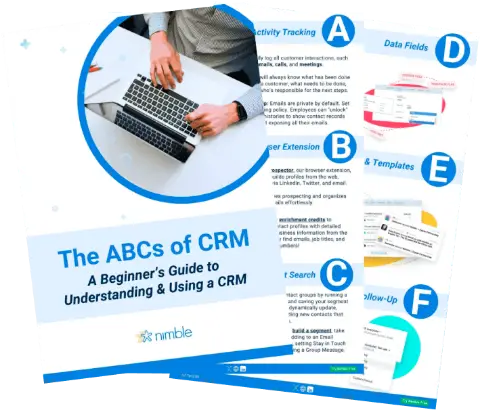
Free Guide
The ABCs of CRM
A Beginner's Guide to Understanding &
Using a CRM
Download Free
You’re All Set!
DownloadGet the most out of this guide by starting your free 14-day trial of Nimble today.
- Free plan (solid on its own).
- Starter: $18 per month per seat.
- Professional: $450 per month (up to 5 seats).
- Enterprise: $1,200+ per month.
Application for Marketing Automation
HubSpot practically invented “inbound marketing automation.” You can build workflows that automatically score leads based on behavior (downloads, clicks, visits), nurture them with personalized emails, and pass them to sales when they’re hot. The integration between CRM and marketing tools is seamless—you can see a full customer journey: from the first blog click to the signed contract.
Zoho CRM – Flexible and Budget-Friendly
Zoho is one of those names that people sometimes underestimate because it doesn’t scream enterprise with a capital E. But it’s powerful, flexible, and crazy affordable.
Description
Zoho CRM has been around for ages, and it covers everything—sales, marketing, support. It’s modular, so you can customize it for your exact workflow. If you’re a small business with a tight budget but big ambitions, Zoho can be molded into something that feels bespoke without breaking the bank.
Features
- Multichannel lead capture (email, chat, social, web forms).
- AI assistant “Zia” for insights and predictions.
- Workflow automation.
- Custom dashboards and reporting.
- Integrates with Zoho’s entire suite (mail, books, projects, etc.).
Pricing
- Free plan for up to 3 users.
- Standard: $14 per user, per month.
- Professional: $23 per user, per month.
- Enterprise: $40 per user, per month.
- Ultimate: $52 per user, per month.
Application for Marketing Automation
Zoho’s automation is surprisingly robust. You can set up workflows that auto-assign leads, send drip campaigns, and score contacts. With Zia, their AI, you even get predictive insights—like which deals are most likely to close. For marketing teams, Zoho is like a Swiss Army knife that costs less than dinner for two.
Salesforce – The Big Dog of CRM
There’s no way around it—Salesforce is the heavyweight. For large enterprises, this is the system that runs entire empires. It’s intimidating, expensive, and can feel overkill for smaller teams, but when used well, it’s unstoppable.
Description
Salesforce isn’t just a CRM. It’s an entire ecosystem with sales, service, marketing, analytics, and even app development built-in. It’s also the most customizable system on the market. If you’ve got developers and admins to fine-tune it, you can bend Salesforce into whatever shape your business requires.
Features
- Cloud-based sales and service platform.
- Advanced lead and opportunity management.
- Powerful workflow automation.
- AI insights via “Einstein.”
- AppExchange marketplace with thousands of add-ons.
- Industry-specific solutions (finance, health, retail, etc.).
Pricing
- Essentials: $25 per user, per month.
- Professional: $80 per user, per month.
- Enterprise: $165 per user, per month.
- Unlimited: $330 per user, per month.
Application for Marketing Automation
Salesforce Marketing Cloud is a beast. You can run massive email campaigns, personalize content with AI, build customer journeys across multiple channels (email, SMS, ads), and track ROI with obsessive detail. For global companies juggling thousands of leads a day, Salesforce doesn’t just automate marketing—it orchestrates it like a conductor leading a symphony.
Pipedrive – The Sales-First CRM
Pipedrive came into the game with a different mindset. Instead of trying to do everything, it focused on sales pipelines—and it nailed it. For businesses that want something simple, visual, and effective, Pipedrive is a breath of fresh air.
Description
Pipedrive is exactly what the name suggests: a pipeline tool that helps salespeople keep deals moving. It’s super visual, with drag-and-drop stages, reminders, and a clean dashboard. Over time, it’s added more automation and marketing features, but it still feels lightweight compared to giants like Salesforce.
Features
- Visual sales pipeline management.
- Custom stages and fields.
- Email sync and tracking.
- Workflow automation.
- Reporting and forecasting.
- Integrations with marketing tools and apps.
Pricing
- Essential: $14 per user, per month.
- Advanced: $29 per user, per month.
- Professional: $49 per user, per month.
- Enterprise: $99 per user, per month.
Application for Marketing Automation
Pipedrive’s automation is designed to keep sales moving. You can set triggers—like “when a lead moves to stage X, send email Y” or “assign a task if no contact for 7 days.” It’s less about big marketing campaigns and more about making sure nobody slips through the cracks. For lean sales teams, it’s a lifesaver.
Comparison – Lining Them Up
If we stack these five side by side, here’s how they feel:
- Nimble: Best for relationship-focused small businesses. Simple, affordable, and very human.
- HubSpot: The best free CRM that can scale into a full-blown marketing/sales/service machine. Great for startups and mid-sized firms.
- Zoho: Crazy value for money. Tons of flexibility, excellent for SMBs that want depth without Salesforce costs.
- Salesforce: Enterprise titan. Ideal for corporations with complex needs, big budgets, and teams to manage the system.
- Pipedrive: Sales-focused and visual. Perfect for smaller teams that just want to move deals efficiently.
Conclusion
So, what’s the “best” CRM experience? It depends. If you’re running a scrappy small business and want a personal touch, Nimble or Pipedrive will feel like a warm sweater. If you’re scaling fast, HubSpot gives you a runway that starts free and grows with you. Zoho is the budget-friendly powerhouse for teams that like to tinker. And Salesforce—well, if you’ve got the money and complexity, it’s the ultimate.
CRM experience isn’t just about software. It’s about how you treat your customers, how smooth their journey feels, and whether they stick around. The right tool doesn’t replace that human touch, but it makes delivering it a hell of a lot easier.